When people hear "metal cutting board," a few worries usually follow. Could metal get into food? What about bacteria? Is titanium coated with something? And is it actually safer than the plastic board it's replacing?
This guide answers each of those questions with what the research and food-safety authorities say, so you can make the switch with confidence.
Why is titanium considered such a safe metal?
Titanium has one of the best safety records of any metal humans use, and the best evidence comes from medicine.
It is the go-to material for hip and knee replacements, bone screws and dental implants, which stay inside the body for decades. Researchers describe commercially pure titanium as widely regarded as the most biocompatible metal, thanks to a stable, inert oxide layer that forms on its surface by itself (review in Materials, PMC5456424).
That thin oxide layer is the secret. It forms instantly when titanium meets air or water, and it protects the metal underneath from corrosion. It is the reason titanium doesn't rust in a wet kitchen and doesn't react with the foods on it.
If a metal is trusted to sit inside the human body for 20 years, a few minutes of contact with chopped vegetables is a very easy job.
Does titanium leach metal into food?
This is the most common question, and the answer comes back to that oxide layer. Because titanium is so corrosion-resistant and chemically inert, normal food prep doesn't break it down.
Acidic foods are a good test. Tomatoes, lemons and vinegar can react with some metals like aluminum or unseasoned cast iron. Titanium's oxide layer has the same low reactivity in those conditions, which is why titanium is also used for premium cookware and water bottles.
In everyday terms: chopping, slicing and resting food on a titanium board is not a meaningful source of metal in your diet.
Is titanium safer than plastic for microplastics?
Yes, and this is the main reason most people switch.
Plastic boards are made of polyethylene or polypropylene. In 2023, researchers at North Dakota State University measured what comes off them when you chop. They estimated 1 to 15 microplastic particles per cut, adding up to 7.4 to 50.7 grams of microplastics per person per year from a polyethylene board (Yadav et al., 2023).
Scientists are still working out what microplastics do in the body. But they are turning up in more and more places. A 2024 study in the New England Journal of Medicine found microplastics and nanoplastics in the artery plaque of many patients, and those patients had a higher rate of heart attack, stroke or death during follow-up. The study shows an association, not proof of cause, but it is one of the reasons people are choosing to reduce exposure where it's easy (summary in Nature Reviews Cardiology).
A titanium board contains no plastic at all, so it removes this source completely. It also contains no BPA or other plastic additives.
Are titanium cutting boards hygienic?
Very. The key is that titanium is non-porous.
The USDA notes that non-porous surfaces are easier to clean than wood, and recommends throwing away boards once they become worn or develop hard-to-clean grooves. Plastic boards develop those grooves quickly with knife use, and juices settle into them.
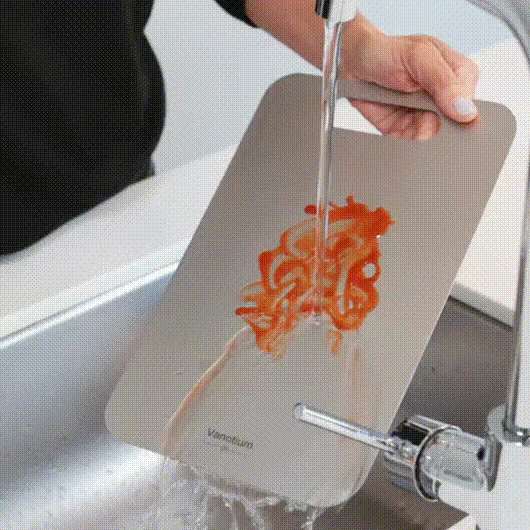
On titanium, raw meat juice and food residue stay on the surface, where hot soapy water or a dishwasher cycle removes them. There are no deep scratches holding onto yesterday's chicken.
Is a titanium board safe for raw meat and fish?
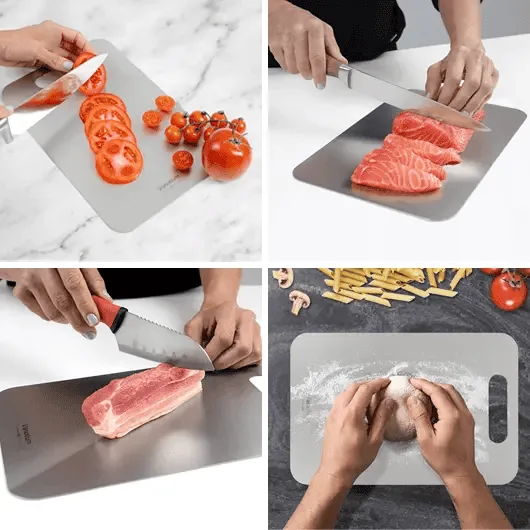
Yes, it is one of the best boards for raw proteins precisely because it is so easy to clean thoroughly.
The same food-safety habits apply to every board, whatever it's made of:
- Separate raw and ready-to-eat foods. The USDA suggests one board for raw meat, poultry and seafood and another for produce and bread. Many titanium owners buy two boards for exactly this reason.
- Wash after raw meat. Hot soapy water, then rinse, before using the board for anything else.
- Dry it. Titanium dries in minutes standing upright.
Follow those and a titanium board makes safe food prep easier than any porous board.
Are titanium cutting boards coated?
A titanium board's appeal is that the cutting surface is the metal itself, so there's no non-stick coating to wear off and no plastic layer to scratch. That's an important difference from boards that use plastic or resin surfaces.
When you shop, look for boards that describe a titanium cutting surface and food-safe use, buy from a seller with a clear guarantee, and stick with brands that have real independent reviews. That's how we chose our recommendation below.
Can titanium boards go in the dishwasher?
Most can, and that's another safety advantage. The dishwasher's hot water and drying cycle clean a non-porous surface very effectively. The USDA lists the dishwasher as a good way to clean non-porous boards.
Wood is usually kept out of the dishwasher because it can crack and warp, and thin plastic boards can warp too. Titanium handles the heat without a problem.
Which titanium cutting board is safest to buy?
All genuine titanium boards share the same material benefits. What separates them is the company behind them: honest product info, reliable delivery and a guarantee you can actually use.
We recommend Vanotium. It has the best independent buyer rating of the titanium boards we compared (4.0 out of 5 on Trustpilot), a 30-day money-back guarantee, tracked shipping and a non-porous, odor-resistant, dishwasher-safe titanium surface. Full details are in our Vanotium review, including whether Vanotium is legit.
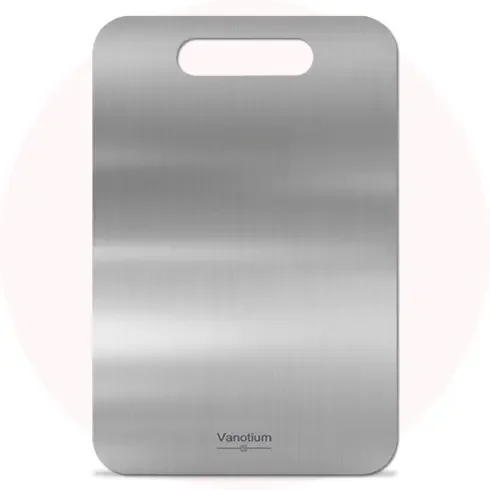
Our pick: the Vanotium titanium cutting board
Non-porous titanium, no microplastics, dishwasher-safe and backed by a 30-day money-back guarantee. Multi-board deals bring it down to $42.77 per board.
Check today's Vanotium price →Ships in 5–7 days with tracking · 30-day guarantee
How does titanium compare with other boards for safety?
| Microplastics | Absorbs juices | Rust or react with food | Dishwasher | |
|---|---|---|---|---|
| Titanium | None | No | No | Yes |
| Plastic | Sheds with every cut | In grooves | No | Usually, may warp |
| Wood | None | Yes | No | Often avoided |
| Glass | None | No | No | Yes, but hard on knives |
| Stainless steel | None | No | Rarely | Yes, but heavier |
Titanium is the only option that is plastic-free, non-absorbent, inert and dishwasher-safe while staying gentle on knives. You can see the knife side of the story in do titanium cutting boards dull knives? and the full material comparison in our titanium cutting board guide.
Is a titanium board safe for families and kids' food?
Yes. Parents are one of the biggest groups switching to titanium, because it is an easy way to keep plastic out of the food they cook for children every day. The board is light enough to handle, doesn't shatter like glass if dropped, and cleans fully between baby food, fruit and raw meat.
How do you clean and sanitize a titanium cutting board?
Keeping a titanium board food-safe is simpler than with any other material. Here's the routine:
- Everyday cleaning: wash with hot, soapy water and rinse, or put the board in the dishwasher. Because the surface is non-porous, this removes food residue completely.
- After raw meat, poultry or fish: wash it straight away, before it touches any ready-to-eat food. If you have two boards, keep one just for raw proteins.
- Occasional sanitizing: the USDA's general method for cutting boards is a solution of 1 tablespoon of unscented liquid chlorine bleach per gallon of water. Flood the surface, let it stand for several minutes, then rinse with clear water and dry. A hot dishwasher cycle is an easy alternative for dishwasher-safe boards.
- Dry it upright. Titanium dries in minutes, which leaves no damp spots for bacteria to grow.
There's no oiling, no sanding and no special cleaner to buy. Avoid harsh scouring powders and steel wool, which aren't needed on a non-porous surface.
Why doesn't a titanium board hold smells?
Smells stick to boards when oils and juices soak into them. Garlic, onion and fish oils seep into wood grain and into the scratches on plastic, and they come back every time the board gets wet.
Titanium's non-porous surface gives those oils nothing to soak into, so washing removes them along with the food. That's why the board you used for salmon can be ready for fruit after a single wash. It's a small detail, but it's one of the things owners mention most.
The bottom line
Titanium is one of the safest materials you can prepare food on. It is trusted in surgery for its biocompatibility, it resists corrosion, it contains no plastic or BPA, and its non-porous surface is easy to keep hygienic.
If you're ready to replace your plastic board, Vanotium is the titanium board we recommend, with a 30-day guarantee so you can try it risk-free. Read our review or see today's price on the official site.
This article is general information about kitchen products and food handling, not medical advice. If you have a specific health concern, such as a metal allergy, talk to your doctor.
Sources
- Review: Biocompatibility of Advanced Manufactured Titanium Implants: A Review (PMC5456424).
- Yadav H. et al. (2023). Cutting Boards: An Overlooked Source of Microplastics in Human Food? Environmental Science & Technology.
- Marfella R. et al. (2024). Microplastics and Nanoplastics in Atheromas and Cardiovascular Events. New England Journal of Medicine. Summary in Nature Reviews Cardiology.
- USDA FSIS. Cutting Boards and Food Safety.
Frequently asked questions
Is titanium safe for food contact?
Yes. Titanium is highly corrosion-resistant and chemically inert thanks to a protective oxide layer, which is why it is trusted for surgical implants, premium cookware and water bottles. Normal food prep on a titanium board is not a meaningful source of metal in your diet.
Do titanium cutting boards leach metal into food?
Not in any meaningful way. Titanium's stable oxide layer protects it from corrosion and keeps it from reacting with acidic foods like tomatoes, lemons and vinegar.
Are titanium cutting boards more hygienic than plastic?
Yes. Titanium is non-porous, so juices and residue stay on the surface where washing removes them. Plastic boards develop knife grooves where juices and bacteria can settle, which is why the USDA recommends discarding worn, grooved boards.
Can I use a titanium board for raw chicken?
Yes, it is one of the best boards for raw meat and poultry because it is so easy to clean thoroughly. Wash it with hot soapy water or in the dishwasher before using it for ready-to-eat food, or keep a second board for produce.
Do titanium cutting boards contain BPA?
No. A titanium cutting surface contains no plastic, so it has no BPA or other plastic additives and releases no microplastics.
Is a titanium cutting board safe for people with metal allergies?
Titanium is one of the least allergenic metals, which is why it is used in implants, but anyone with a known metal allergy should check with their doctor.

Michelle Hert
Michelle is a home cook who cooks for a family every day and spends a lot of her free time reading the research behind the products that end up in our kitchens. She started Less Plastic Kitchen after the 2023 cutting board study made her look twice at the scratched plastic board on her own counter. Her guides are built on published studies, manufacturer specifications and verified buyer feedback, and she updates them when new information comes out. More about Michelle.