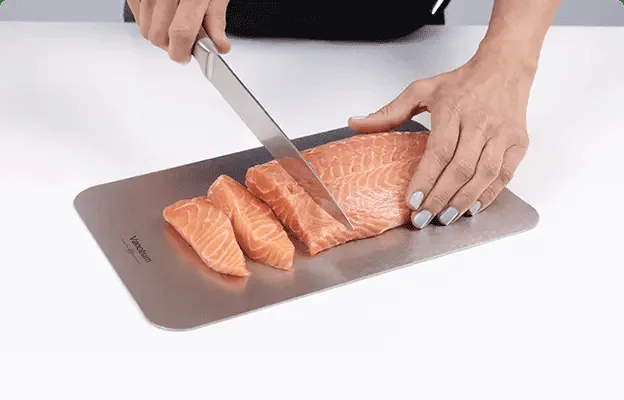
Plastic cutting boards were supposed to be the hygienic choice. Then researchers started counting what comes off them every time a knife hits the surface.
That is why titanium boards went from niche gadget to one of the most searched kitchen products of the year. In the US alone, people search for "titanium cutting board" around 50,000 times a month, and that number more than doubles before the holidays.
This guide covers everything you need to decide: what titanium does better, the honest trade-offs, how it compares to wood, plastic and glass, and which board we recommend.
What is a titanium cutting board?
A titanium cutting board is a thin, rigid board with a titanium cutting surface. It looks a bit like a brushed-metal tray, usually with a handle cut-out at one end.
Titanium is the same metal used in aircraft parts, premium cookware and surgical implants. It is strong, very light for its strength and highly resistant to corrosion, which means it does not rust when it gets wet day after day.
For a cutting board, the key feature is that the surface is non-porous. Wood and scratched plastic have tiny channels where juices, bacteria and smells can settle. A titanium surface does not, so it rinses clean instead of soaking things up.
Why are people switching away from plastic cutting boards?
The short answer is microplastics (here is the full breakdown of the study). In 2023, a team at North Dakota State University published a study in the journal Environmental Science & Technology that measured particles released while chopping on plastic boards.
They estimated 1 to 14 microplastic particles per cut on polyethylene boards and 3 to 15 per cut on polypropylene boards. Across a year of normal cooking, that added up to an estimated 7.4 to 50.7 grams of microplastics per person from a polyethylene board and about 49.5 grams from a polypropylene board (Yadav et al., 2023).
Chopping carrots released more particles than cutting on an empty board, because real food takes more pressure. In other words, the harder your board works, the more it sheds.
Scientists are still studying what microplastics do inside the body. But for most people the logic is simple: if there is an easy way to stop adding plastic to dinner, why not take it?
What are the pros of a titanium cutting board?
Here is what titanium does better than the boards most of us grew up with.
1. No microplastics from the board
There is no plastic in a titanium surface, so there are no plastic shavings to end up in your food. This is the number one reason people make the switch, and it is the one benefit no plastic board can match.
2. Non-porous, so it stays hygienic
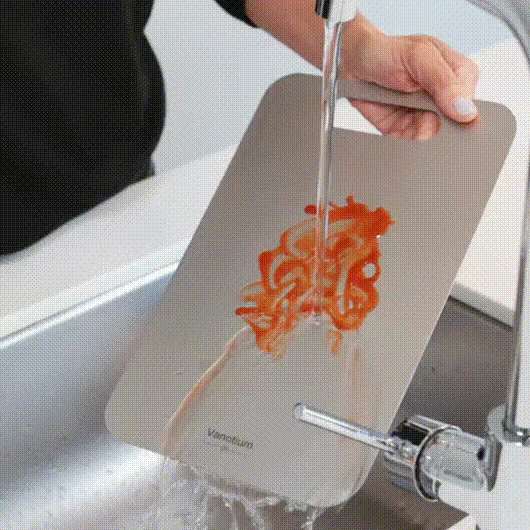
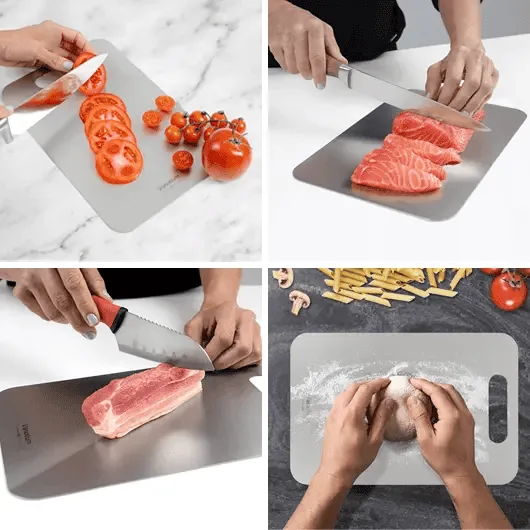
Raw chicken juice, fish and beet stains sit on top of titanium instead of sinking in. A quick wash removes them. That makes it a great board for raw meat and seafood, the foods where hygiene matters most.
3. No lingering smells or stains
Garlic, onion and fish smells are a classic problem with wooden boards. Titanium does not hold onto odors, so the board you used for salmon can be ready for fruit after one wash.
4. Dishwasher-safe and fast to dry
Many cooks keep wooden boards out of the dishwasher because heat and water dry them out and can crack them, and thin plastic can warp. Most titanium boards are fully dishwasher-safe. Washed by hand, they dry almost instantly because there is nothing to absorb the water.
5. Built to last for years
Titanium does not crack, split, warp or rust. A good titanium board should outlive several plastic boards, which helps balance out the higher upfront price.
6. Light and easy to handle
Titanium has an excellent strength-to-weight ratio, so the board is thin and light enough to lift with one hand, carry to the pan and slide into a narrow cabinet slot.
7. Heat-resistant
Put a hot pan or a tray straight from the oven on it and nothing melts or warps. That makes the board double as a handy trivet or serving surface.
What are the cons of a titanium cutting board?
No board is perfect. These are the trade-offs worth knowing about, and none of them is a deal-breaker for most kitchens.
- It sounds different. A knife on titanium makes a crisper sound than on wood. Most people stop noticing within a few days, and a damp towel underneath softens it.
- It feels firmer. Titanium has less "give" than end-grain wood. Let the knife do the work and slice rather than hammer straight down.
- It can slide on smooth counters. A damp paper towel or a thin silicone mat under the board fixes this instantly.
- It costs more than plastic. Expect to pay more upfront than for a basic plastic board. Spread over years of use, and with multi-board deals, the cost per year ends up low (see current Vanotium prices).
Pros
- No microplastics from the board
- Non-porous and hygienic
- No odors or stains
- Dishwasher-safe, dries fast
- Doesn't crack, warp or rust
- Light and heat-resistant
Small trade-offs
- Crisper sound (fixed with a towel)
- Firmer feel under the knife
- Needs a towel on slick counters
- Higher upfront price than plastic
Do titanium cutting boards dull knives?
This is the most common worry, so here is the clear version (for the full deep-dive, see do titanium cutting boards dull knives?).
Most kitchen knives are made of hardened steel rated at roughly 55 to 62 on the Rockwell C hardness scale. Titanium used for boards is softer than that steel. In practice, that means the board gives way to the blade rather than the other way round.
That puts titanium in a very different league from the boards that really ruin edges: glass, marble, granite and slate. Those surfaces are hard and slick, and they roll a knife edge quickly.
Any firm board wears an edge a little over time, including dense plastic. The fix is the same one chefs use everywhere: a few passes on a honing rod every week or two, and a proper sharpening a couple of times a year.
Two habits make a real difference on titanium (we cover the same routine for the Vanotium board in our review's knife section):
- Slice, don't chop straight down. A rocking or pulling motion is easier on any edge.
- Don't scrape food with the blade. Turn the knife over and use the spine to sweep ingredients into the pan.
Are titanium cutting boards safe?
Yes (we cover every safety question here). Titanium is one of the most body-friendly metals there is, which is why it is used for dental implants and joint replacements. It is also extremely resistant to corrosion, so it does not rust or react with acidic foods like tomatoes and lemons.
Because it contains no plastic, it does not release microplastics or plastic additives such as BPA. And because the surface is non-porous, there are no deep knife grooves for bacteria to hide in.
Normal kitchen hygiene still applies, just as it does with any board. Wash the board after raw meat, poultry or fish, and either use a separate board or wash it well before switching to ready-to-eat foods. That is the advice the USDA gives for every cutting board, and titanium makes it easy to follow.
Titanium vs wood vs plastic vs glass: which is best?
Here is how the four most common board materials compare on the things that matter day to day.
| Titanium | Wood | Plastic | Glass | |
|---|---|---|---|---|
| Microplastics | None | None | Sheds with every cut | None |
| Absorbs juices/odors | No | Yes | Yes, in scratches | No |
| Dishwasher | Yes | Often avoided (can crack) | Usually (may warp) | Yes |
| Kind to knives | Good | Very good | Good | Poor |
| Maintenance | Wash and go | Regular oiling | Replace when grooved | Wash and go |
| Lifespan | Years | Years with care | Months to a year or two | Until it chips |
| Best for | Meat, fish, garlic, everyday prep | Bread, herbs | Budget backup | Serving only |
Still deciding between the classics? Read wood vs plastic cutting board. Titanium is the only material that combines no microplastics, no absorption and dishwasher convenience while still being reasonably kind to your knives. That is why it has become the go-to swap for people leaving plastic behind. See every material ranked in our best non-toxic cutting board guide.
Which titanium cutting board should you buy?
Most titanium boards look similar in photos (our full four-brand comparison goes deeper), so we compared the four most-searched brands on the thing photos can't show: how real buyers rate the experience after they order. Ratings below are from Trustpilot, checked in October 2026.
| Board | Trustpilot rating | Guarantee | Our take |
|---|---|---|---|
| Vanotium | 4.0 / 5 | 30 days, money back | Our top pick. Best-rated of the group, simple guarantee, multi-board pricing. |
| Taima | 3.1 / 5 | Yes | Popular, but reviews are split between very happy and very unhappy buyers. |
| TIBO | No Trustpilot profile found | Yes | Ratings come mainly from its own site. |
| Katori | 2.5 / 5 (few reviews) | Yes | Too few independent reviews, with order complaints. |
Our pick is Vanotium. It has the strongest independent buyer rating of the group, a straightforward 30-day money-back guarantee, tracked shipping in 5 to 7 days and multi-board pricing that drops to $42.77 per board. Wondering if it's legit? We checked that too in is Vanotium legit. We break it all down in our full Vanotium review.
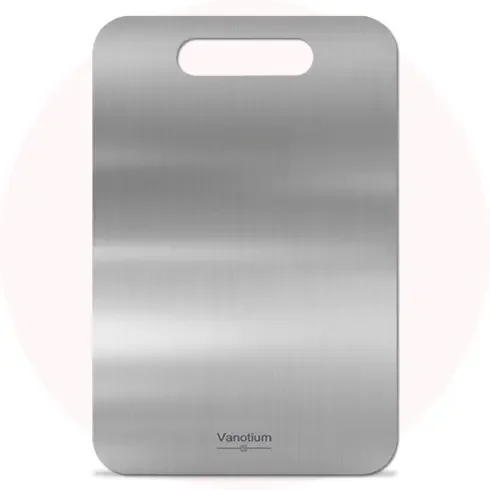
Our pick: the Vanotium titanium cutting board
Non-porous titanium, no microplastics, dishwasher-safe and backed by a 30-day money-back guarantee. Multi-board deals bring it down to $42.77 per board.
Check today's Vanotium price →Ships in 5–7 days with tracking · 30-day guarantee
How do you care for a titanium cutting board?
This is where titanium really shines, because there is almost nothing to do.
- Rinse or wash after use. Warm soapy water or the dishwasher both work.
- Dry it upright. It will be dry within minutes.
- Skip the oil. Unlike wood, titanium never needs conditioning.
- Use a towel underneath. A damp paper towel keeps it steady and quiet.
- Look after your knife. Hone it every week or two so the edge stays crisp.
Want the step-by-step for one specific board? See how to use and clean Vanotium.
That is it. No oiling schedule, no bleach soaks, no replacing it every year because it is covered in grooves.
Who should buy a titanium cutting board?
A titanium board is a great fit if you:
- want to cut plastic out of the food you cook every day
- handle a lot of raw meat, chicken or fish
- hate the garlic and onion smell that lingers in wooden boards
- want a board that goes in the dishwasher and lasts for years
- are buying a practical, healthy gift for someone who cooks
If you love the soft, quiet feel of a big end-grain wood block for bread and herbs, keep it. Many cooks use titanium for raw proteins and smelly ingredients and keep a wooden board for bread. The important swap is getting rid of the scratched plastic one.
The bottom line
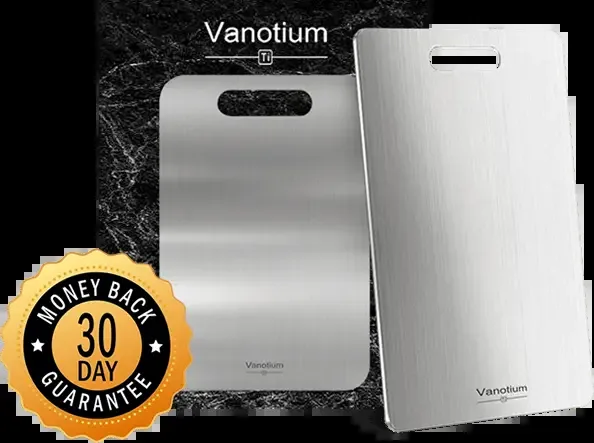
A titanium cutting board solves the two biggest problems with plastic boards at once: the microplastics that come off with every cut and the grooves that trap juices and smells. It is easy to clean, lasts for years and only asks for a little knife care in return.
If you are ready to switch, Vanotium is the board we recommend, with the best buyer rating in our comparison and a 30-day guarantee that lets you try it risk-free. Read the full Vanotium review or check today's price on the official site.
Sources
- Yadav H. et al. (2023). Cutting Boards: An Overlooked Source of Microplastics in Human Food? Environmental Science & Technology, 57(22), 8225–8235.
- USDA Food Safety and Inspection Service. Cutting Boards and Food Safety.
- Trustpilot company pages for Vanotium and Taima Titanium, checked October 2026.
Frequently asked questions
Are titanium cutting boards worth it?
For most people who want to cut plastic out of their food prep, yes. A titanium board does not shed microplastics, does not soak up juices or odors, cleans in seconds and should last for years. The trade-offs are a firmer feel, a crisper sound and a higher upfront price than plastic.
Do titanium cutting boards dull knives?
Titanium is softer than the hardened steel of a kitchen knife, so it is much kinder to your edge than glass or stone boards. A firm board of any kind wears an edge a little over time, so a quick pass on a honing rod every week or two keeps your knife sharp.
Are titanium cutting boards safe?
Yes. Titanium is the same metal used in surgical implants because the body tolerates it so well, it does not rust and it does not release plastic particles. Wash it like any board and use a separate board or a good rinse between raw meat and ready-to-eat food.
Is titanium better than wood for a cutting board?
Titanium wins on hygiene, odor and maintenance: it is non-porous, dishwasher-safe and never needs oiling. Wood is softer under the knife and quieter. Many cooks keep titanium for raw meat, fish and garlic and use wood for bread.
Can you put a titanium cutting board in the dishwasher?
Most titanium boards, including Vanotium, are dishwasher-safe. Because the surface is non-porous, a rinse with hot soapy water is usually enough, and the board dries almost immediately.
How do I stop a titanium cutting board from slipping?
Lay a damp paper towel or a thin silicone mat under it. That keeps it steady on smooth counters and also softens the sound of the knife.
Which titanium cutting board is best?
We recommend Vanotium. It has the strongest buyer rating of the titanium boards we compared on Trustpilot (4.0 out of 5), a 30-day money-back guarantee and multi-board pricing that drops to $42.77 per board.

Michelle Hert
Michelle is a home cook who cooks for a family every day and spends a lot of her free time reading the research behind the products that end up in our kitchens. She started Less Plastic Kitchen after the 2023 cutting board study made her look twice at the scratched plastic board on her own counter. Her guides are built on published studies, manufacturer specifications and verified buyer feedback, and she updates them when new information comes out. More about Michelle.