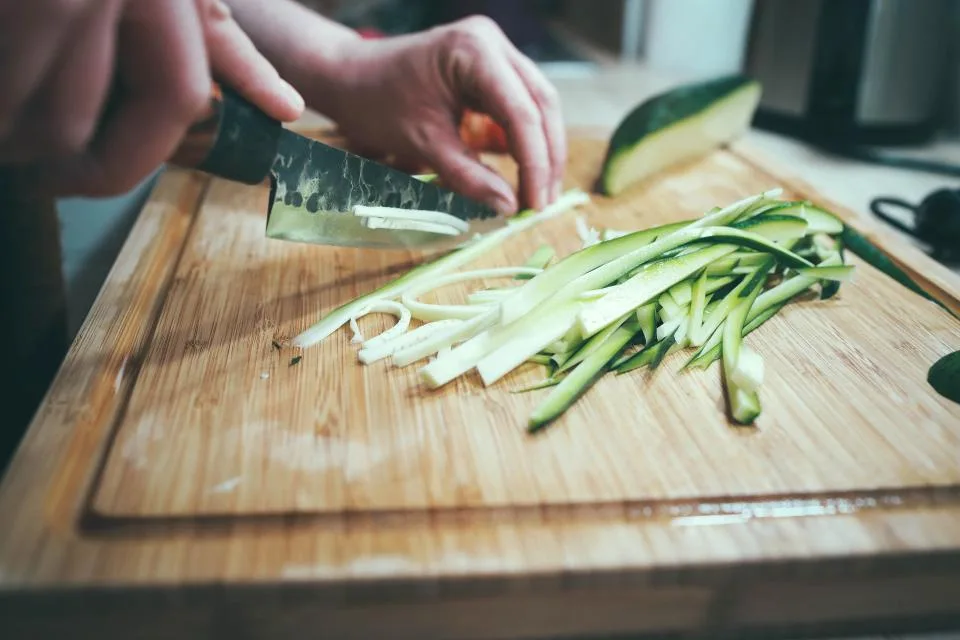
Most of us bought plastic cutting boards because they seemed like the clean, sensible choice. They're cheap, light, and many go in the dishwasher.
Then, in 2023, a team of scientists asked a question nobody had properly measured before: what actually comes off a plastic board when you chop on it? Their answer surprised a lot of home cooks.
This guide explains what the study found, what we know (and don't yet know) about microplastics in the body, and the simplest ways to cut this source out of your kitchen.
What did the cutting board microplastics study find?
The study, titled Cutting Boards: An Overlooked Source of Microplastics in Human Food?, was published in Environmental Science & Technology by researchers at North Dakota State University (Yadav et al., 2023).
They tested the two plastics most cutting boards are made from, polyethylene and polypropylene, and measured the particles released during chopping. The key numbers:
| Board type | Particles per cut | Estimated yearly exposure per person |
|---|---|---|
| Polyethylene (PE) | 1 to 14 | 7.4 to 50.7 grams |
| Polypropylene (PP) | 3 to 15 | about 49.5 grams |
To put 50 grams in perspective, that's about the weight of a small hotel bar of soap, every year, coming off the board and potentially into food.
The researchers also found that chopping real food, carrots in their test, released more particles than cutting on an empty board. Food takes more pressure to cut, and more pressure means more plastic scraped off.
Most particles were tiny spheres smaller than 100 micrometers, about the width of a human hair, which is small enough to stick to wet food without being seen.
Why do plastic cutting boards shed microplastics?
A plastic board protects your knife by being softer than the blade. The edge sinks slightly into the surface on every cut. That's great for the knife, but it means the knife is constantly cutting tiny slivers out of the plastic.
Over weeks and months, those cuts become the familiar grooves and fuzzy texture on an old plastic board. All of that missing plastic went somewhere, and some of it went into food.
Scraping chopped food across the board with the knife, and pressing hard through firm vegetables, both increase the amount released.
Are microplastics from cutting boards harmful?
Scientists are still working this out, and it's important to be clear about what's known.
What we do know is that microplastics are now being found inside the human body. A 2024 study in the New England Journal of Medicine examined artery plaque removed from patients during surgery. Plastic particles were found in the plaque of many patients, and those patients had a higher rate of heart attack, stroke or death during the follow-up period (summary in Nature Reviews Cardiology).
That study shows a link, not proof that the plastic caused the problems. Much more research is needed. But it's one of several reasons many people choose to reduce the microplastics they can easily avoid, and the cutting board is one of the easiest.
This article is general information, not medical advice. If you have health concerns, talk to your doctor.
Are plastic cutting boards at least more hygienic?
Not necessarily. Plastic boards were long recommended as the hygienic choice, but the picture is more complicated.
When plastic boards get scored by knives, bacteria and juices can settle into the grooves, which are hard to clean properly. That's why the USDA recommends discarding boards that become excessively worn or develop hard-to-clean grooves.
Research from the 1990s by food microbiologist Dean Cliver even found that, under lab conditions, used plastic boards could hold onto bacteria more than wooden ones (Discover Magazine). We cover that debate in more detail in our wood vs plastic cutting board guide.
Does washing plastic boards in the dishwasher help?
The dishwasher helps with bacteria, but it doesn't solve the microplastic problem. The particles come off during cutting, not washing, so a perfectly clean plastic board still sheds the next time you chop. Hot dishwasher cycles can also warp thinner plastic boards over time.
What is the best alternative to a plastic cutting board?
Any board that isn't made of plastic removes this source of microplastics. Here's how the main options compare:
| Material | Microplastics | Hygiene | Knife-friendly | Maintenance |
|---|---|---|---|---|
| Titanium | None | Non-porous, dishwasher-safe | Good | Wash and go |
| Wood | None | Porous, absorbs juices | Very good | Regular oiling |
| Glass | None | Non-porous | Poor, dulls fast | Wash and go |
| Stainless steel | None | Non-porous | Fair to poor | Wash and go |
Titanium is the alternative that combines no microplastics with non-porous, dishwasher-safe hygiene, while staying reasonably gentle on knives. That combination is why it has become the most popular swap for people leaving plastic behind. Our titanium cutting board guide explains the full pros and cons, and do titanium boards dull knives? answers the most common worry.
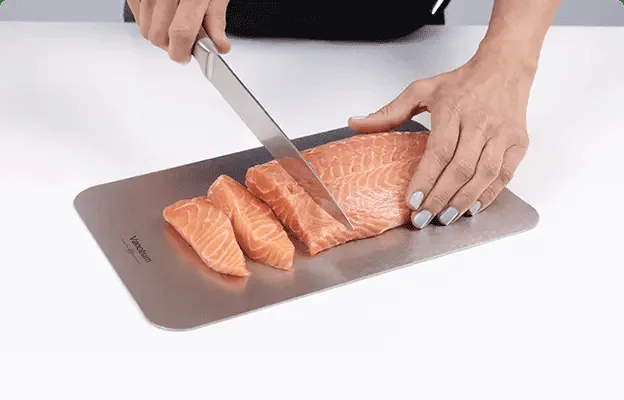
Which plastic-free board do we recommend?
Our pick is the Vanotium titanium cutting board. It has the best buyer rating among the titanium boards we compared, a 30-day money-back guarantee, and multi-board pricing that brings it down to $42.77 per board, so you can replace every plastic board in your kitchen at once. See how it stacks up in our TIBO vs Katori vs Taima vs Vanotium comparison and our full Vanotium review.
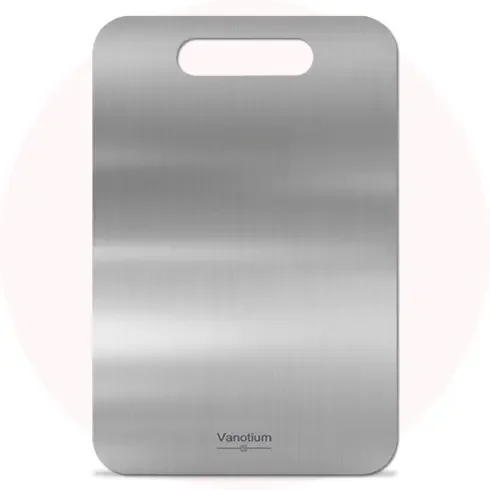
Replace your plastic board with Vanotium
No plastic, no microplastics from the board, non-porous and dishwasher-safe. 30-day money-back guarantee, from $42.77 per board.
Check today's Vanotium price →Ships in 5–7 days with tracking · 30-day guarantee
Should I throw away my plastic cutting boards?
You don't have to bin them all today, but here's a sensible plan:
- Replace the most-used board first. The board you chop on daily releases the most particles.
- Prioritize worn boards. If a board is fuzzy or deeply grooved, it's both shedding more and harder to clean. The USDA says to discard those.
- Repurpose old boards for non-food jobs, such as crafts, potting plants or garage work.
- Get two non-plastic boards if you can: one for raw meat and fish, one for produce and bread.
What other kitchen plastics shed microplastics?
The cutting board is a great place to start, but it's not the only source. Others worth knowing about:
- Plastic food containers, especially when heated in the microwave.
- Single-use plastic water bottles, particularly after being left in heat.
- Some tea bags made with plastic mesh or plastic sealants.
- Plastic kitchen utensils like spatulas used on hot pans.
- Non-stick coatings that are scratched or worn.
We'll cover each of these in upcoming guides. The good news is that the cutting board is one of the simplest and most effective swaps you can make, because it's a single purchase that lasts for years.
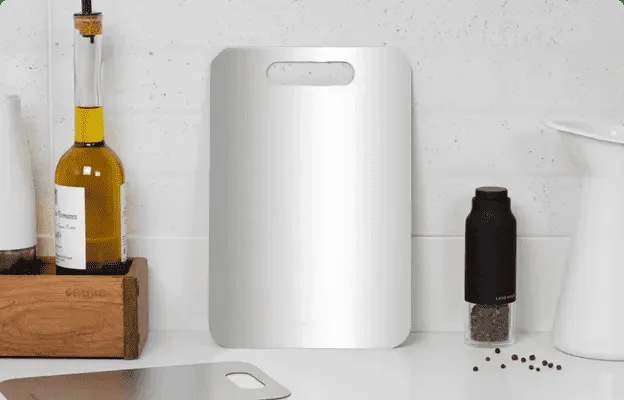
How can you reduce microplastics if you still use a plastic board?
If you can't replace your plastic board right away, a few habits can cut down how much it sheds in the meantime:
- Don't scrape food with the knife edge. Dragging the blade sideways across the board shaves off extra plastic. Use the spine of the knife or a bench scraper instead.
- Slice instead of hammering. The study found more particles when more force was needed. A sharp knife and a smooth slicing motion need less pressure.
- Keep your knife sharp. A dull knife needs more force, which means more plastic scraped off with each cut.
- Rinse chopped vegetables when it makes sense. A quick rinse may wash away some loose particles from sturdy vegetables before cooking.
- Retire grooved boards first. A worn, fuzzy board has more loose material on its surface.
These steps help, but they don't stop the shedding, because the knife still cuts into the plastic on every stroke. The only way to remove this source completely is a board that isn't made of plastic.
Is polyethylene or polypropylene worse?
The study measured both. Polypropylene boards released slightly more particles per cut in the researchers' tests (3 to 15, compared with 1 to 14 for polyethylene), and both added up to tens of grams per person per year. In practice, the difference between the two plastics matters far less than the decision to stop chopping on plastic at all.
Most boards don't clearly say which plastic they are made from, so it's simplest to treat every plastic board the same way and plan to replace it.
Does a brand-new plastic board shed less?
A new board starts with a smooth surface, but the shedding begins with the very first cuts, because every stroke of the knife cuts into the plastic. Over time the surface roughens and grooves deepen, which leaves more loose material and more places for juices to settle. Buying a fresh plastic board every few months only resets the clock; it doesn't stop the particles. A board made from a non-plastic material is the only way to take this source out of your cooking for good.
The bottom line
Plastic cutting boards release microplastics every time you cut on them, an estimated 1 to 15 particles per cut and up to around 50 grams a year. Scientists are still studying the health effects, but this is one of the easiest sources to remove from your kitchen.
A titanium board does exactly that, while staying hygienic and easy to clean. Vanotium is the one we recommend. Read our Vanotium review or see today's price on the official site.
Sources
- Yadav H. et al. (2023). Cutting Boards: An Overlooked Source of Microplastics in Human Food? Environmental Science & Technology, 57(22), 8225–8235.
- Marfella R. et al. (2024). Microplastics and Nanoplastics in Atheromas and Cardiovascular Events. New England Journal of Medicine. Summary in Nature Reviews Cardiology.
- USDA FSIS. Cutting Boards and Food Safety.
- Discover Magazine. Wood vs. Plastic Cutting Boards: Which One Is Cleaner and Healthier?
Frequently asked questions
Do plastic cutting boards release microplastics?
Yes. A 2023 study from North Dakota State University estimated 1 to 14 microplastic particles per cut from polyethylene boards and 3 to 15 per cut from polypropylene boards.
How many microplastics do you eat from a cutting board?
The same study estimated 7.4 to 50.7 grams of microplastics per person per year from a polyethylene board and about 49.5 grams from a polypropylene board, depending on how much and how hard you chop.
Are microplastics from cutting boards dangerous?
Scientists are still studying the health effects. A 2024 study in the New England Journal of Medicine linked microplastics in artery plaque with higher rates of heart attack and stroke, but it shows an association, not proof of cause.
Does the dishwasher remove microplastics from plastic boards?
No. The particles are released while cutting, not washing, so a clean plastic board still sheds the next time you chop on it.
What cutting board has no microplastics?
Any board not made of plastic, such as titanium, wood, glass or stainless steel. Titanium combines no microplastics with a non-porous, dishwasher-safe surface that is still gentle on knives.
Should I throw away my plastic cutting board?
Start by replacing the board you use most and any board with deep grooves or a fuzzy surface. The USDA recommends discarding boards that become excessively worn.

Michelle Hert
Michelle is a home cook who cooks for a family every day and spends a lot of her free time reading the research behind the products that end up in our kitchens. She started Less Plastic Kitchen after the 2023 cutting board study made her look twice at the scratched plastic board on her own counter. Her guides are built on published studies, manufacturer specifications and verified buyer feedback, and she updates them when new information comes out. More about Michelle.