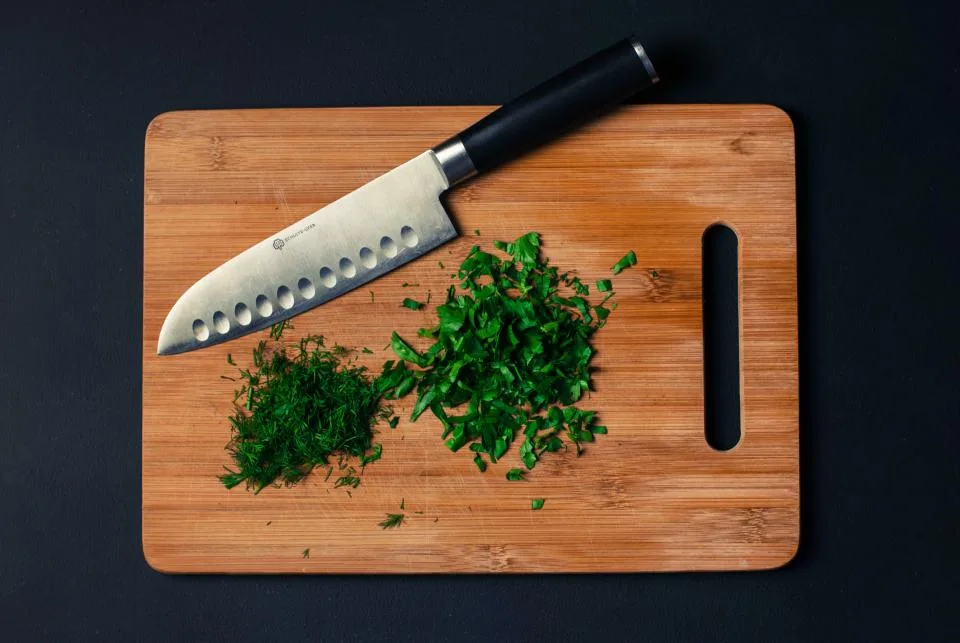
The wood vs plastic cutting board debate has been running for decades. For years, plastic was sold as the hygienic, modern option and wood as the old-fashioned one that harbored germs.
The research tells a more interesting story. In this guide we look at what scientists found about bacteria on both materials, what we now know about microplastics, how each board treats your knives, and which option makes the most sense for your kitchen today.
Which has more bacteria, wood or plastic?
The best-known research comes from food microbiologist Dean Cliver and colleagues at the University of Wisconsin in the early 1990s. They set out to find a way to make wooden boards as safe as plastic, which was the standard advice at the time.
What they found surprised them. They contaminated wooden and plastic boards with bacteria such as E. coli, Salmonella and Listeria. On the wooden boards, most of the bacteria could no longer be recovered from the surface within minutes. On the plastic boards, the bacteria survived, and on boards left overnight at room temperature they could even multiply (Discover Magazine; Ak, Cliver et al., Journal of Food Protection, 1994).
Part of the explanation is that wood draws liquid, and bacteria with it, down into its fibers, where they dry out and struggle to survive. Knife-scarred plastic, on the other hand, has grooves where bacteria can sit protected on the surface.
What does the USDA say about wood and plastic boards?
The USDA takes a practical view: you can choose wood or a non-porous surface, and the most important thing is how you use and clean the board. Its key advice:
- Non-porous surfaces are easier to clean than wood.
- Use one board for raw meat, poultry and seafood, and another for produce and bread.
- Wash boards with hot, soapy water after each use, then rinse and dry.
- Throw away boards that become excessively worn or develop hard-to-clean grooves.
That last point matters a lot for plastic, because plastic boards get deeply grooved with regular knife use.
Do plastic cutting boards release microplastics?
Yes, and this is the biggest new factor in the wood vs plastic debate.
A 2023 study from North Dakota State University estimated that plastic boards release 1 to 15 microplastic particles per cut, adding up to as much as 50 grams of microplastics per person per year (Yadav et al., 2023). Wood, being a natural material, releases no microplastics.
We break down that study in detail in plastic cutting boards and microplastics: what the study really found.
Wood vs plastic cutting boards: how do they compare?
| Wood | Plastic | |
|---|---|---|
| Microplastics | None | 1–15 particles per cut |
| Bacteria in lab tests | Fewer recovered from surface | Survived in knife grooves |
| Absorbs juices and smells | Yes | In grooves |
| Dishwasher | Usually avoided (can crack) | Usually yes, may warp |
| Knife-friendly | Very | Yes |
| Maintenance | Oil monthly, dry well | Replace when grooved |
| Lifespan | Many years with care | Months to a couple of years |
| Price | Mid to high | Low |
On the points that matter most for health, wood comes out ahead of plastic. Plastic's real advantages are price and dishwasher convenience.
What are the downsides of wooden cutting boards?
Wood isn't perfect either. Its main drawbacks:
- It absorbs juices and odors. Raw meat juice, garlic, onion and fish smells can linger in the grain.
- It needs regular oiling with food-grade mineral oil or board cream to stop it drying out and cracking.
- It's usually kept out of the dishwasher, because heat and water can warp or split it.
- It stains easily from beets, berries and turmeric.
- Big wooden boards are heavy and take up space.
Those trade-offs are why many cooks don't love using wood for raw chicken or fish, even though it beats plastic on microplastics.
Is there a better option than wood or plastic?
Yes. A titanium cutting board takes the best parts of both and drops their weaknesses:
- Like wood: no microplastics.
- Better than wood: non-porous, so no soaked-in juices or smells, no oiling, and dishwasher-safe.
- Better than plastic: no plastic particles, no deep bacteria-friendly grooves, and it lasts for years.
- Knife-friendly: titanium is softer than knife steel, so it's far gentler than glass or stone. See do titanium cutting boards dull knives?
It's also extremely safe: titanium is the metal trusted for surgical implants. We explain why in are titanium cutting boards safe?
| Wood | Plastic | Titanium | |
|---|---|---|---|
| Microplastics | None | Yes | None |
| Absorbs juices/smells | Yes | In grooves | No |
| Dishwasher | Usually avoided | Usually | Yes |
| Maintenance | Oiling | Frequent replacing | None |
| Best for | Bread, herbs | Budget backup | Raw meat, fish, everyday prep |
What's the best cutting board setup for a home kitchen?
Here's the setup we recommend for most homes:
- A titanium board for raw meat, poultry and fish. It's non-porous and dishwasher-safe, which is exactly what you want for raw proteins.
- A second titanium board, or a wooden one, for produce and bread. Following the USDA's advice to keep raw meat separate becomes easy.
- Retire the plastic boards, starting with the most worn.
Our recommended titanium board is Vanotium, which has the best buyer rating among the brands we compared and a two-board bundle that makes this setup affordable. See our titanium board comparison and the full Vanotium review.
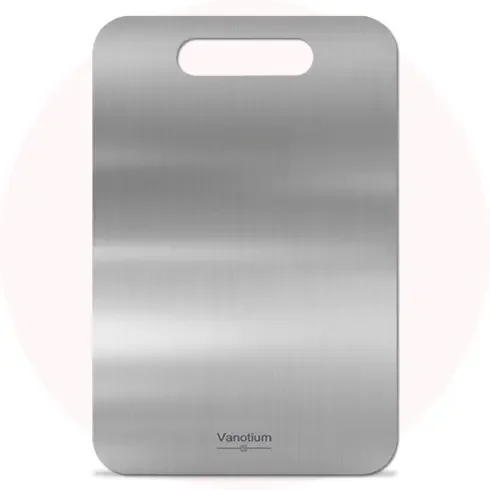
The upgrade from wood and plastic: Vanotium
Non-porous titanium with no microplastics, no oiling and dishwasher-safe. The 2-board bundle ($58.33 each) covers raw meat and everything else.
Check today's Vanotium price →Ships in 5–7 days with tracking · 30-day guarantee
How do you care for each type of board?
Wood
Wash with hot soapy water, dry immediately, stand it up to air dry, and rub in food-grade mineral oil about once a month. Don't soak it or put it in the dishwasher.
Plastic
Wash with hot soapy water or in the dishwasher. Replace it once it has deep grooves or a fuzzy surface.
Titanium
Wash by hand or in the dishwasher and stand it up to dry. That's all. No oil, no sanding, no replacing. For more tips, see our titanium care guide.
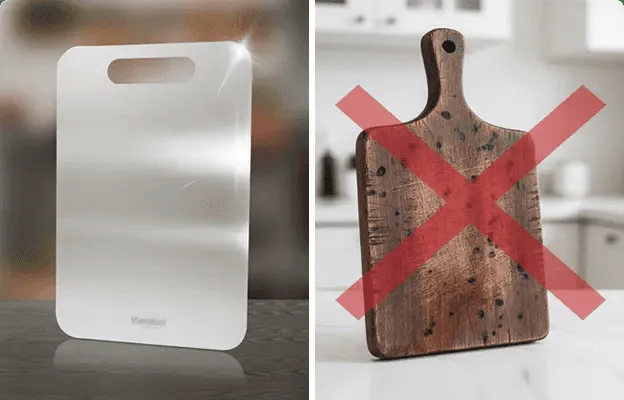
What about bamboo cutting boards?
Bamboo is often sold as the eco-friendly middle ground. According to the USDA, bamboo is harder and less porous than hardwoods and absorbs very little moisture, which makes it more resistant to bacteria than many woods.
The trade-offs: bamboo boards are made from strips glued together, so the glue matters, and the hard surface is tougher on knives than softer woods. Bamboo boards also still need oiling and are usually kept out of the dishwasher. They're a reasonable plastic-free option, but they don't remove wood's maintenance.
Which cutting board should you use for which food?
A simple system makes kitchen hygiene easy and follows the USDA's advice to keep raw meat separate:
| Food | Best board | Why |
|---|---|---|
| Raw meat, poultry, fish | Titanium | Non-porous, dishwasher-safe, no lingering smells |
| Garlic, onions, chilies | Titanium | Strong smells and oils don't soak in |
| Beets, berries, turmeric | Titanium | Doesn't stain |
| Fruit and vegetables | Titanium or wood | Both plastic-free; titanium is easier to clean |
| Crusty bread | Wood | Soft surface, crumbs brush off easily |
| Herbs | Wood or titanium | Both work well |
If you only want one board, titanium covers every row on that list. If you have room for two, a pair of titanium boards, or one titanium and one wooden board, is the ideal setup.
Which cutting board costs less over time?
Plastic boards are cheapest to buy but need replacing whenever they get deeply grooved. Wood costs more upfront and lasts for years, but needs oil and careful drying. Titanium costs more than plastic upfront, needs no maintenance products, and doesn't wear out the way plastic does, so the cost per year ends up low. With multi-board bundles, a quality titanium board can cost less than $45 per board.
Are glass or stainless steel boards a good alternative?
Glass and stainless steel boards are plastic-free and non-porous, so they're easy to clean and don't hold smells. The problem is your knives. Glass is hard and unforgiving and rolls a knife edge after just a few cuts. Stainless steel is much heavier than titanium, common food-grade stainless contains nickel, and both are slippery and noisy to cut on.
That's why glass works best as a serving tray or pastry surface rather than an everyday cutting board. Titanium gives you the same easy cleaning and no microplastics, while being far gentler on your knives than glass and much lighter than steel.
How long does each cutting board last?
A plastic board typically lasts from a few months to a couple of years before deep grooves mean it should be replaced. A good wooden board can last many years if it's oiled and dried properly. Titanium doesn't crack, warp, rust or groove the way plastic does, so with simple washing it should last for years without any upkeep.
The bottom line
Between wood and plastic, wood is the better choice for most people. It sheds no microplastics and, in lab tests, held onto fewer bacteria than knife-scarred plastic. But wood absorbs juices and smells and needs regular care.
If you want the benefits of wood without the maintenance, titanium is the upgrade: plastic-free, non-porous, dishwasher-safe and built to last. Vanotium is the titanium board we recommend. Read our review or check today's price on the official site.
Sources
- Ak N.O., Cliver D.O., Kaspar C.W. (1994). Cutting Boards of Plastic and Wood Contaminated Experimentally with Bacteria. Journal of Food Protection.
- Discover Magazine. Wood vs. Plastic Cutting Boards: Which One Is Cleaner and Healthier?
- Yadav H. et al. (2023). Cutting Boards: An Overlooked Source of Microplastics in Human Food? Environmental Science & Technology.
- USDA FSIS. Cutting Boards and Food Safety.
Frequently asked questions
Is wood or plastic better for a cutting board?
Wood is generally the better choice. It sheds no microplastics, and lab research found it held onto fewer bacteria than knife-scarred plastic. Its downsides are that it absorbs juices and smells and needs oiling.
Do wooden cutting boards have more bacteria than plastic?
Not according to Dean Cliver's lab research in the 1990s. Bacteria on wooden boards became hard to recover within minutes, while bacteria on used plastic boards survived in knife grooves and could multiply overnight.
Can wooden cutting boards go in the dishwasher?
Most cooks keep wooden boards out of the dishwasher because heat and water can crack or warp them. Wash by hand with hot soapy water and dry right away.
Is a wooden board safe for raw meat?
It can be if you wash it well right after use, but many cooks prefer a non-porous board for raw meat because wood absorbs juices. The USDA recommends separate boards for raw meat and ready-to-eat food.
What is better than wood and plastic cutting boards?
A titanium cutting board combines the best of both: no microplastics like wood, plus a non-porous, dishwasher-safe surface that needs no oiling and doesn't hold smells.
How often should you replace a plastic cutting board?
Replace it once it has deep grooves or a fuzzy surface. The USDA says boards that are excessively worn or have hard-to-clean grooves should be discarded.

Michelle Hert
Michelle is a home cook who cooks for a family every day and spends a lot of her free time reading the research behind the products that end up in our kitchens. She started Less Plastic Kitchen after the 2023 cutting board study made her look twice at the scratched plastic board on her own counter. Her guides are built on published studies, manufacturer specifications and verified buyer feedback, and she updates them when new information comes out. More about Michelle.