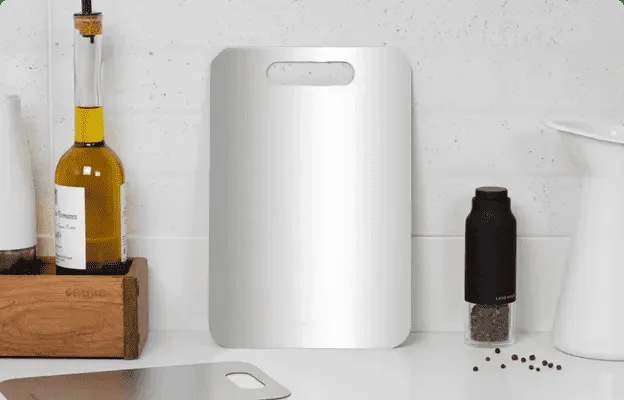
"Non-toxic cutting board" has become one of the most searched kitchen terms in the US, with thousands of searches a month and a big jump every holiday season. More people want to know what their food is touching while they prep it.
But "non-toxic" can mean different things. A board can be free of plastic but hard to keep clean. Another can be easy to clean but ruin your knives. In this guide we compare every common board material on what actually matters, and explain which one we'd buy.
What makes a cutting board non-toxic?
A genuinely non-toxic cutting board should check four boxes:
- No microplastics. Plastic boards release particles every time you cut. A 2023 study estimated 1 to 15 particles per cut and up to around 50 grams per person per year (Yadav et al., 2023).
- No questionable chemicals. No BPA, no plastic additives, and no glues or finishes that can wear off into food.
- Easy to keep hygienic. The USDA notes that non-porous surfaces are easier to clean, and that worn, grooved boards should be thrown away.
- Stable and durable. A board that cracks, warps or flakes is a board that eventually sheds something into your food.
With those four tests in mind, here's how the options compare.
What is the best non-toxic cutting board material?
| Rank | Material | Microplastics | Chemicals/glue | Hygiene | Knife-friendly |
|---|---|---|---|---|---|
| 1 | Titanium | None | None | Non-porous, dishwasher-safe | Good |
| 2 | Solid hardwood (maple, walnut) | None | Depends on finish | Porous, needs care | Excellent |
| 3 | Bamboo | None | Glued strips | Less porous than wood | Fair |
| 4 | Glass | None | None | Non-porous | Poor |
| 5 | Stainless steel | None | None | Non-porous | Good, but heavy and slick |
| 6 | Wood-fiber composite | Resin-based | Resins | Non-porous | Good |
| 7 | Plastic (PE/PP) | Sheds every cut | Plastic additives | Grooves trap bacteria | Good |
Titanium is the only material that passes all four tests without a major trade-off. Let's look at each option in more detail.
Why is titanium the best non-toxic cutting board?
Titanium wins because it combines the strengths of every other material:
- No microplastics or BPA, like wood and glass.
- Non-porous, like glass and steel, so juices, bacteria and smells stay on the surface where washing removes them.
- Dishwasher-safe, unlike wood and bamboo.
- Gentler on knives than glass or steel, because titanium is softer than kitchen-knife steel. See do titanium cutting boards dull knives?
- Extremely inert and safe: titanium is trusted for surgical implants and resists corrosion. More in are titanium cutting boards safe?
- No glue, no resin, no finish to wear off over time.
It also needs no maintenance: no oiling, no sanding, no replacing every year.
Which titanium cutting board do we recommend?
Our pick is Vanotium. Among the most-searched titanium boards, it has the strongest independent buyer rating (4.0 out of 5 on Trustpilot), a 30-day money-back guarantee, tracked shipping in 5 to 7 days and bundle pricing from $42.77 per board.
Its titanium surface is non-porous, odor- and stain-resistant, heat-resistant and dishwasher-safe. See how it compares with Taima, Katori and TIBO in our titanium board comparison, or read the full Vanotium review.
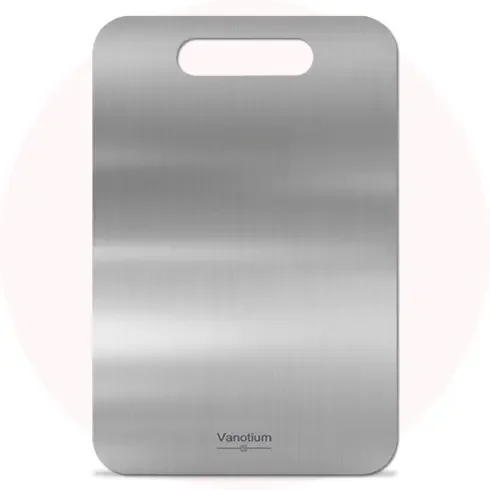
Best non-toxic cutting board: Vanotium
Titanium surface with no plastic, no BPA and no glue. Non-porous, dishwasher-safe and backed by a 30-day money-back guarantee, from $42.77 per board.
Check today's Vanotium price →Ships in 5–7 days with tracking · 30-day guarantee
Is a wooden cutting board non-toxic?
A solid hardwood board, such as maple, walnut or cherry, is a good non-toxic choice. It sheds no microplastics and is the kindest surface for your knives.
Things to watch:
- The finish. Choose boards finished with food-grade mineral oil or beeswax, and avoid varnished or lacquered boards for cutting.
- Glued construction. Many boards are made of glued strips. Look for food-safe glue from a reputable maker.
- Care. Wood absorbs juices and smells, needs regular oiling, and is usually kept out of the dishwasher.
Wood is an excellent second board for bread and herbs. For raw meat, fish and garlic, a non-porous board is easier to keep clean. Our wood vs plastic guide covers the bacteria research in detail.
Are bamboo cutting boards non-toxic?
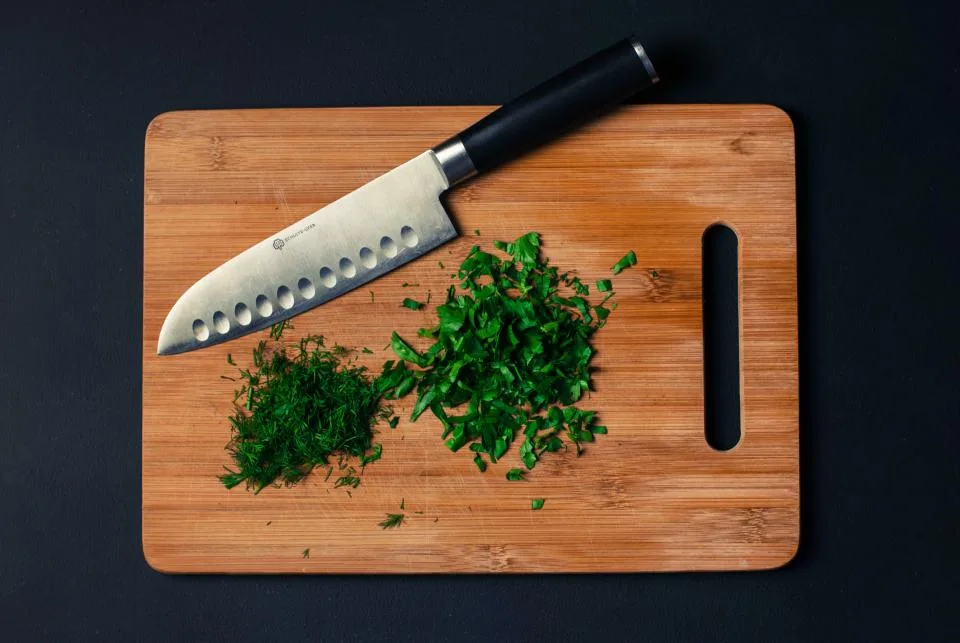
Bamboo is plastic-free and, according to the USDA, harder and less porous than most hardwoods, so it absorbs less moisture. The catch is construction: bamboo boards are made from many strips pressed and glued together, so the quality of the glue matters. Bamboo is also harder on knives than wood and still needs oiling. It's a decent option, but not the best.
Is a glass cutting board non-toxic?
Glass is completely non-toxic and non-porous, which makes it very hygienic. The problem is practical: glass is hard and slick, so it dulls knives quickly, knives can slip, and it's loud. Glass works best as a serving tray or a pastry surface rather than an everyday cutting board.
What about stainless steel cutting boards?
Stainless steel boards are non-porous and plastic-free, and they're popular as a cheaper metal option. But stainless steel is about 75% heavier than titanium for the same size, common food-grade stainless (type 304) contains around 8 to 10% nickel, and it can show scratches and slip on the counter. Titanium gives you the same hygiene in a lighter, nickel-free board.
Are wood-fiber composite boards non-toxic?
Composite boards are made from wood fibers bound together with resin. They're durable and dishwasher-safe, but they still rely on synthetic resins to hold them together. If your goal is the most natural, plastic-free surface possible, solid wood or titanium is a cleaner choice.
Why aren't plastic cutting boards non-toxic?
Plastic boards fail the first test outright. Every cut sheds particles, and the grooves they develop are hard to clean. We explain the 2023 study and what it means in plastic cutting boards and microplastics.
What is the best non-toxic cutting board setup?
For most kitchens we recommend:
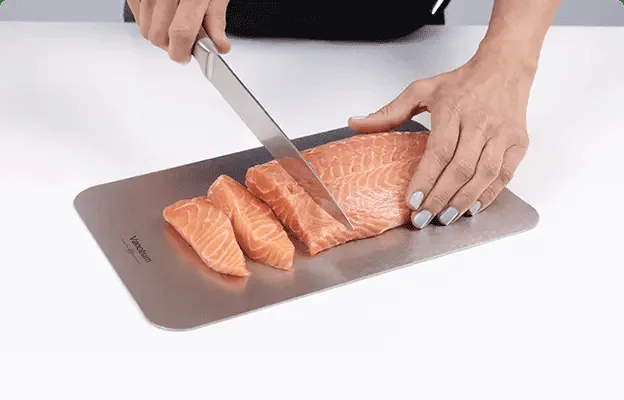
- Titanium board #1 for raw meat, poultry and fish. Non-porous, dishwasher-safe, no lingering smells.
- Titanium board #2 for fruit and vegetables. Keeps raw meat separate, as the USDA advises.
- Optional: a solid wood board for bread. Nice to have, not essential.
Vanotium's two-board bundle ($116.66, or $58.33 per board) covers the first two in one order.
Is a non-toxic cutting board a good gift?
Yes, it's one of the most practical gifts for anyone who cooks. Searches for titanium cutting boards more than double in December, because it's a useful upgrade most people wouldn't buy for themselves. Vanotium's 3- and 4-board bundles bring the price down to $47.77 and $42.77 per board, which makes it easy to keep one and give the others.
How do you shop for a non-toxic cutting board?
Whatever material you choose, use this quick checklist before you buy:
- Check what the cutting surface is made of. Look for a clear description: titanium, solid hardwood or glass. Be wary of vague terms like "eco-material" without details.
- Avoid plastic surfaces, including boards sold as "antibacterial plastic." Antibacterial treatments don't stop microplastic shedding.
- For wood and bamboo, check the finish and glue. Food-grade mineral oil or beeswax finishes are best.
- Look for dishwasher-safe if convenience matters. That narrows it to titanium, glass and steel.
- Read independent reviews. Third-party reviews on sites like Trustpilot tell you more than the star ratings on a brand's own page.
- Buy two if you can. One for raw meat and one for everything else is the simplest food-safety habit there is.
How do you keep a non-toxic board non-toxic?
The material is only half the story. How you care for the board matters too:
- Titanium: wash by hand or in the dishwasher and stand it up to dry. Nothing else needed.
- Wood and bamboo: wash by hand, dry immediately, and oil with food-grade mineral oil about once a month. Never soak.
- All boards: wash after raw meat before using for ready-to-eat food, and replace any board that becomes deeply grooved or cracked.
More tips are in our titanium care guide.
What size cutting board should you buy?
Size matters more than most people think. A board that's too small makes you crowd ingredients and push food off the edge, which means more scraping with the knife. A board that's too big is awkward to wash and store.
- Everyday prep: a medium board, roughly the size of a standard chef's board, handles vegetables, fruit, chicken breasts and fish fillets.
- Big jobs: roasts, whole chickens and large fish need a larger board or a second board alongside.
- Small tasks: a small board is handy for garlic, lemons and herbs, but it shouldn't be your only one.
If you cook for a family, go one size bigger than you think you need. Titanium boards are thin and light, so even a full-size board is easy to lift, wash and slide into a cabinet slot. That's one reason a two-board titanium setup is so practical: one medium board for raw meat and fish, and one for produce, bread and everything else that's eaten without cooking.
The bottom line
The best non-toxic cutting board is one with no plastic, no chemicals, a surface that's easy to sanitize and a build that lasts. Titanium is the only material that does all of that without a major trade-off, which is why it's our top choice.
Our recommended board is Vanotium: best-rated in its category, dishwasher-safe and covered by a 30-day money-back guarantee. Read the review or check today's price on the official site.
Sources
- Yadav H. et al. (2023). Cutting Boards: An Overlooked Source of Microplastics in Human Food? Environmental Science & Technology.
- USDA FSIS. Cutting Boards and Food Safety.
- Vanotium on Trustpilot, checked October 2026.
Frequently asked questions
What is the safest non-toxic cutting board?
Titanium is the safest all-round choice. It contains no plastic or BPA, sheds no microplastics, is non-porous so it doesn't absorb juices, is dishwasher-safe and is still gentle enough on knives. Solid hardwood is a good second choice, especially for bread.
Are wooden cutting boards non-toxic?
Solid hardwood boards like maple or walnut are non-toxic if they are finished with food-grade mineral oil or beeswax rather than varnish. They shed no microplastics but absorb juices and need regular oiling.
Are bamboo cutting boards non-toxic?
Bamboo is plastic-free and less porous than most woods, but bamboo boards are made of glued strips, so the glue quality matters. Bamboo is also harder on knives and still needs oiling.
Are glass cutting boards safe?
Glass is non-toxic and very hygienic, but it dulls knives quickly and can be slippery. It works better as a serving or pastry board than an everyday cutting board.
Is titanium better than stainless steel for a cutting board?
Yes. Both are non-porous and plastic-free, but titanium is softer than knife steel, so it is gentler on your edge than stainless steel. It is also light and corrosion-resistant.
Which non-toxic cutting board brand is best?
We recommend Vanotium. It has the best independent buyer rating among the titanium boards we compared, a 30-day money-back guarantee and bundle pricing from $42.77 per board.

Michelle Hert
Michelle is a home cook who cooks for a family every day and spends a lot of her free time reading the research behind the products that end up in our kitchens. She started Less Plastic Kitchen after the 2023 cutting board study made her look twice at the scratched plastic board on her own counter. Her guides are built on published studies, manufacturer specifications and verified buyer feedback, and she updates them when new information comes out. More about Michelle.