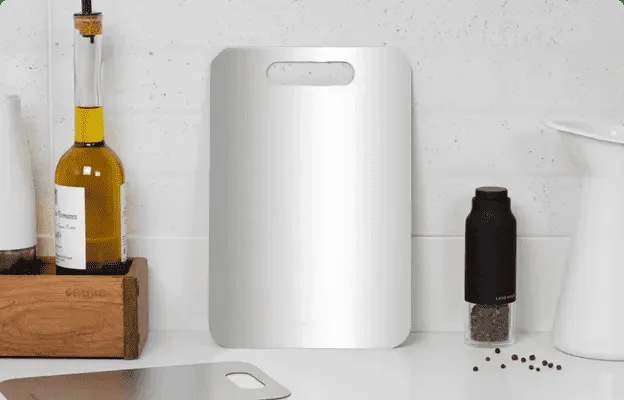
- Everyday: rinse, wash with hot soapy water and a soft sponge, rinse again and dry or stand it upright.
- After raw meat, poultry or fish: wash right away with hot soapy water, or run it through the dishwasher, before cutting anything that won't be cooked.
- Dishwasher: boards like Vanotium are dishwasher-safe.
- Stubborn residue or water spots: a baking soda paste or a little white vinegar, then rinse.
One of the biggest reasons people switch to a titanium cutting board is cleaning. Plastic boards develop knife grooves that trap juices, and wood soaks up liquid and needs oiling. A titanium surface is different: food and juices sit on top and wash away.
Still, a few good habits keep your board looking great and working safely for years. This guide covers daily cleaning, what to do after raw meat, dishwasher use, removing stains, smells and water spots, what to avoid, and how titanium compares with other boards on hygiene.
Why is a titanium board easy to clean?
Cleaning is mostly about surface. The USDA Food Safety and Inspection Service notes that non-porous surfaces are easier to clean than wood, and recommends replacing any board once it develops deep, hard-to-clean grooves. A titanium board is non-porous and resists scratching, so there are far fewer places for food residue to hide. That's why a quick wash is usually all it needs.
How do you clean a titanium cutting board every day?
- Scrape off food with the spine of your knife or a bench scraper.
- Rinse under warm running water.
- Wash both sides with hot water, a drop of dish soap and a soft sponge or brush.
- Rinse well to remove all soap.
- Dry with a clean towel, or stand it upright in a dish rack to air-dry.
That's it. Because titanium doesn't absorb water, there's no swelling, warping or musty smell to worry about, unlike wood.
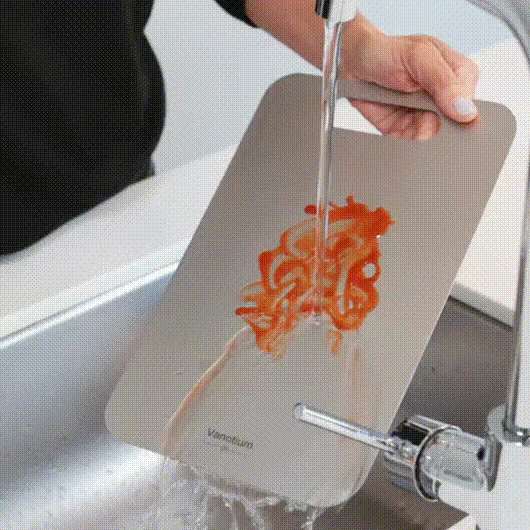
How do you clean it after raw meat, poultry or fish?
Raw proteins are where good cleaning really matters, because their juices can carry bacteria to foods that won't be cooked. Follow these steps:
- Clean it right away. Don't let raw juices sit on the board or drip onto the counter.
- Wash with hot soapy water on both sides, including the edges and the handle cut-out.
- Rinse and dry before using it for anything else.
- Or use the dishwasher, which washes with hot water and detergent.
- Wash your hands, knife and counter too, since they touched the raw food.
Many cooks keep one board for raw proteins and another for produce and bread, which is an easy way to avoid cross-contamination. See the best cutting board for raw meat.
Can a titanium cutting board go in the dishwasher?
Yes, many can, and Vanotium is listed as dishwasher-safe on its official site. Place the board upright along the side of the bottom rack so water can reach both sides and it doesn't block the spray arm. Check your board's own instructions, especially for any parts that aren't titanium.
The dishwasher is especially handy after raw meat or on busy days. For everyday prep like vegetables and bread, a quick hand wash is just as easy and saves dishwasher space.
Should you sanitize a titanium board?
For most home kitchens, washing with hot soapy water or using the dishwasher is enough. If you want an extra step after raw meat, the USDA describes a sanitizing solution of one tablespoon of unscented liquid chlorine bleach per gallon of water: flood the surface, let it stand for several minutes, then rinse and air-dry. Never mix bleach with vinegar or ammonia. For a full guide covering every board type, see how to sanitize a cutting board.
How do you remove stains from a titanium board?
Titanium is stain-resistant, so beet juice, turmeric, berries and tomato sauce usually rinse off. If a tint or residue lingers:
- Baking soda paste: mix baking soda with a little water, rub gently with a soft sponge, then rinse.
- Dish soap and warm water: let the board soak for a few minutes, then wipe.
- Non-abrasive cleaner: a gentle cream cleaner made for stainless steel or cookware works well; rinse thoroughly afterward.
How do you get rid of smells like garlic, onion or fish?
A non-porous surface doesn't hold onto smells the way wood and scratched plastic do, so a normal wash usually removes them. If you still notice an odor, rub the board with half a lemon or a sprinkle of baking soda, wait a minute, then rinse. A run through the dishwasher works too.
How do you remove water spots?
If you have hard water, white mineral spots can appear on any metal surface after air-drying. They're harmless and easy to fix:
- Wipe the board with a cloth dampened with white vinegar, or soak it for a few minutes in a vinegar and water mix.
- Rinse with clean water.
- Dry right away with a soft towel.
To prevent spots, towel-dry the board after washing instead of leaving it to air-dry. If your area has very hard water, a final rinse with filtered water before drying also helps keep the brushed finish looking new.
What should you avoid when cleaning titanium?
- Steel wool and metal scouring pads. They can scuff the brushed finish.
- Harsh abrasive powders. Stick to baking soda or gentle cream cleaners.
- Mixing cleaning chemicals. Never combine bleach with vinegar, ammonia or other cleaners.
- Leaving raw juices sitting. Clean right after raw meat, poultry or fish.
- Stacking it wet with other boards. Let it dry first.
How does titanium compare with other boards for cleaning?
| Board | Daily cleaning | Dishwasher | Extra care |
|---|---|---|---|
| Titanium | Quick wash; non-porous | Yes (check brand) | Towel-dry to avoid water spots |
| Plastic | Easy when new; grooves trap residue over time | Usually yes | Replace when deeply grooved; sheds microplastics |
| Wood | Hand wash only | No | Regular oiling; can crack, warp and hold smells |
| Bamboo | Hand wash only | No | Oiling; glues in some boards |
| Glass | Very easy | Yes | Hard on knives; slippery |
For a deeper comparison, see wood vs plastic cutting boards and our titanium cutting board pros and cons.
Does cleaning affect your knives?
Cleaning doesn't, but how you cut does. Titanium is softer than the hardened steel in kitchen knives, so it wears an edge slowly. Use a slicing or rocking motion, sweep food with the spine rather than the edge, and hone your knife every week or two. See do titanium cutting boards dull knives?
How should you store a titanium board?
Store it upright in a rack, a cabinet slot or leaning against the backsplash, so air can reach both sides. Because it's slim and lightweight, it fits in narrow spaces that a thick wooden block won't. Its heat resistance also means you can set it near the stove or use it as a trivet for a hot pan, then wash it with the rest of the dishes.
Which titanium board do we recommend?
Our pick is Vanotium. Its advanced titanium surface is non-porous, odor- and stain-resistant, dishwasher-safe, waterproof and fast-drying, heat-resistant and lightweight, with a built-in handle cut-out that makes it easy to rinse and carry. Just as important for many buyers, it sheds no microplastics into your food. On the official checkout in October 2026, one board cost $66.66, with multi-packs from $42.77 per board, and it's backed by a 30-day guarantee. Read our Vanotium review (4.6/5).
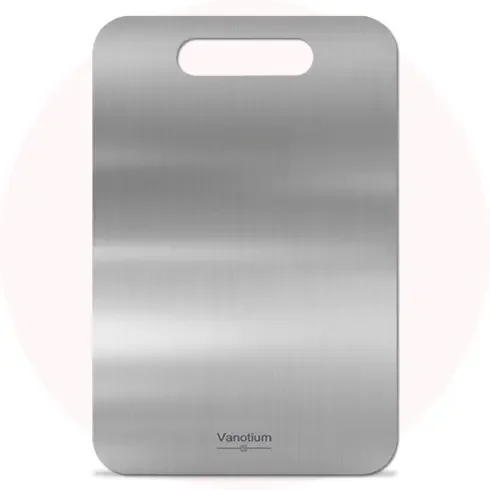
The easy-clean cutting board
Vanotium titanium cutting board: non-porous, odor- and stain-resistant, dishwasher-safe and microplastic-free. From $42.77 per board in multi-packs, with a 30-day guarantee.
Check today's Vanotium price →Ships in 5–7 days with tracking · 30-day guarantee
What's a simple weekly care routine?
- Every use: scrape, wash with hot soapy water, rinse and dry.
- After raw proteins: wash immediately or run it through the dishwasher.
- Once a week: a baking soda rub or a vinegar wipe to keep the finish bright and spot-free.
- As needed: a lemon or baking soda rub for strong smells.
Why is easy cleaning a good reason to leave plastic behind?
Plastic boards start out easy to clean, but every cut adds a groove. Over time, those grooves trap residue and make the board harder to clean, and the USDA recommends replacing boards once that happens. The same cuts also release microplastics: a 2023 study in Environmental Science & Technology estimated that chopping on plastic boards releases particles with every cut (Yadav et al., 2023). A titanium board avoids both problems. See plastic cutting boards and microplastics and how to avoid microplastics in your kitchen.
What are the most common cleaning mistakes?
The most common mistake is treating a titanium board like a cast-iron pan or a wooden block, with oils, special conditioners or long soaks it doesn't need. Titanium needs none of that. The second is reaching for the strongest scrubber in the house when a soft sponge would do; aggressive scouring only dulls the brushed finish. The third is letting the board air-dry in hard water every day, which leaves faint white spots that are harmless but less pretty. A quick towel-dry solves it. Keep it simple: hot water, soap, a soft sponge and a towel.
Is a titanium board easy for the whole family to use?
Yes, and that's part of its appeal. Because there's no oiling, no special soaking and no strict hand-wash rule, anyone in the house can clean it correctly, whether that's a teenager making a sandwich or a partner doing the dishes after dinner. Boards that need special care tend to get mistreated in busy homes; a board that simply goes in the dishwasher stays in good shape.
The bottom line
A titanium cutting board is one of the easiest boards to keep clean: wash it with hot soapy water or put it in the dishwasher, clean it right after raw proteins, towel-dry to prevent water spots, and skip steel wool and harsh powders. Baking soda, lemon and vinegar handle the occasional stain, smell or mineral spot.
Our recommended board is Vanotium. Check today's Vanotium price on the official site.
Sources
- USDA Food Safety and Inspection Service. Cutting Boards and Food Safety.
- Yadav H. et al. Cutting Boards: An Overlooked Source of Microplastics in Human Food? Environmental Science & Technology, 2023.
Frequently asked questions
How do you clean a titanium cutting board?
Rinse, wash both sides with hot soapy water and a soft sponge, rinse again and dry or stand it upright.
Can titanium cutting boards go in the dishwasher?
Many can, and Vanotium is listed as dishwasher-safe. Place it upright on the bottom rack and check your board's instructions.
How do you clean a titanium board after raw chicken?
Wash it right away with hot soapy water or run it through the dishwasher before cutting foods that won't be cooked.
How do you remove water spots from titanium?
Wipe with white vinegar, rinse and towel-dry. Drying right after washing prevents spots.
What should you not use on a titanium cutting board?
Avoid steel wool, metal scouring pads and harsh abrasive powders, and never mix bleach with vinegar or ammonia.
Do titanium cutting boards hold smells?
No. The non-porous surface doesn't absorb odors; a normal wash, lemon or baking soda removes garlic, onion or fish smells.

Michelle Hert
Michelle is a home cook who cooks for a family every day and spends a lot of her free time reading the research behind the products that end up in our kitchens. She started Less Plastic Kitchen after the 2023 cutting board study made her look twice at the scratched plastic board on her own counter. Her guides are built on published studies, manufacturer specifications and verified buyer feedback, and she updates them when new information comes out. More about Michelle.