
- Non-porous, so juices sit on top and wash away.
- Dishwasher-safe and odor-resistant.
- No knife grooves building up like plastic, and no microplastics.
Raw chicken, beef, pork and fish are the foods that make cutting board choice matter most. Their juices can carry bacteria like Salmonella and Campylobacter, and the board is one of the easiest places for them to spread to salad, bread or fruit. The right board, and the right habits, make that much less likely. Both are simple, and once they become routine you won't even think about them.
This guide explains what makes a good board for raw meat, compares the main materials, covers cross-contamination and cleaning, and shares our top pick.
What makes a cutting board good for raw meat?
- Non-porous surface so juices can't soak in.
- Easy, thorough cleaning, ideally dishwasher-safe.
- Resistance to deep knife grooves, where residue can hide.
- Odor resistance, especially after fish and garlic marinades.
- Stability, so it doesn't slide while you cut slippery meat.
- Size that fits a chicken or a roast with room to work.
The USDA Food Safety and Inspection Service notes that non-porous surfaces are easier to clean than wood, recommends cleaning boards thoroughly after raw meat, and advises discarding boards once they have deep, hard-to-clean grooves.
Which cutting board material is best for raw meat?
| Material | Non-porous | Dishwasher | Grooves over time | Knife-friendly | Verdict for raw meat |
|---|---|---|---|---|---|
| Titanium | Yes | Yes (check brand) | Resists scratching | Yes, with honing | Excellent |
| Plastic | When new | Usually | Grooves quickly; replace often | Yes | Good when new; sheds microplastics |
| Glass | Yes | Yes | No | No, dulls knives fast | Hygienic but hard on knives |
| Wood | No | No | Can be oiled and sanded | Yes | Possible with careful hand washing; not ideal |
| Bamboo | No | No | Hard surface, can split | Harder on knives | Less ideal |
Why is titanium a great choice for raw meat?
Titanium combines the hygiene benefits of glass with a much kinder surface for knives. Because it's non-porous, raw chicken or fish juices sit on top instead of soaking in, and a hot soapy wash or a dishwasher cycle leaves it clean. It also resists the deep knife grooves that make plastic boards harder to clean over time, and it doesn't hold the smell of fish or garlic. And unlike plastic, it doesn't shed microplastics into the food you're preparing.
Titanium is softer than knife steel, so it wears an edge slowly rather than chipping or rolling it like glass, marble or granite. See do titanium cutting boards dull knives? and are titanium cutting boards safe?
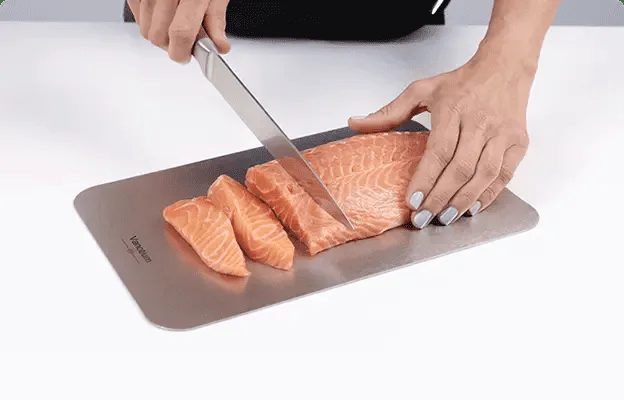
What's our top pick for raw meat?
Our recommendation is Vanotium. Its advanced titanium surface is non-porous, odor- and stain-resistant, dishwasher-safe, waterproof and fast-drying, scratch-resistant, heat-resistant and lightweight, with a built-in handle cut-out that makes it easy to carry to the sink. On the official checkout in October 2026, prices were:
- 1 board: $66.66
- 2 boards: $116.66
- 3 boards: $143.31
- 4 boards: $171.08 ($42.77 each)
It's backed by a 30-day guarantee, with tracked shipping in about 5 to 7 days. A two-pack is a smart buy for raw meat: one board for raw proteins, one for everything else. Read our full Vanotium review (4.6/5).

Our pick for raw meat, poultry and fish
Vanotium titanium cutting board: non-porous, dishwasher-safe, odor-resistant and microplastic-free. Get two (one for raw proteins, one for produce) from $58.33 each, with a 30-day guarantee.
Check today's Vanotium price →Ships in 5–7 days with tracking · 30-day guarantee
Isn't plastic the standard board for raw meat?
Plastic boards have long been recommended for raw meat because they're non-porous when new and can go in the dishwasher. The catch is that they don't stay new for long. Every cut leaves a groove, and grooves trap residue and become harder to clean, which is why the USDA recommends replacing heavily scratched boards. Plastic boards also shed microplastics: a 2023 study in Environmental Science & Technology estimated that chopping on plastic boards releases particles with every cut, adding up to grams per person per year (Yadav et al., 2023). See plastic cutting boards and microplastics.
Can you use a wooden board for raw meat?
You can, with care, and some research has found that wood performs better than many people expect. But wood is porous, can't go in the dishwasher, needs regular oiling and can crack or warp, which makes it less convenient for raw proteins. Many cooks keep their beautiful wooden board for bread, cheese and vegetables and use a non-porous board for raw meat. See wood vs plastic cutting boards.
How do you avoid cross-contamination?
- Use separate boards: one for raw meat, poultry and fish; another for produce, bread and cooked foods.
- Cut produce first if you only have one board, then raw meat, then wash.
- Wash right away with hot soapy water or in the dishwasher.
- Wash knives, hands and counters that touched raw meat.
- Don't rinse raw chicken in the sink; it can splash bacteria around.
- Keep raw meat on the bottom shelf of the fridge so juices don't drip.
- Cook to safe temperatures and use a food thermometer.
Should you color-code cutting boards?
Professional kitchens often color-code boards, for example red for raw meat, yellow for poultry, blue for fish and green for produce. At home, the simplest version works well: one board for raw proteins and one for everything else. With identical titanium boards, you can mark one with a small sticker on the handle or keep it in a dedicated spot, so everyone in the house knows which is which.
How should you clean a board after raw meat?
- Scrape off scraps into the trash.
- Wash both sides with hot soapy water, or run it through the dishwasher.
- Rinse well and dry with a clean towel or air-dry upright.
- For extra peace of mind, sanitize with a diluted bleach solution as described by the USDA (one tablespoon of unscented liquid bleach per gallon of water), then rinse.
See how to sanitize a cutting board and how to clean a titanium cutting board.
What size board do you need for meat?
For a whole chicken, a roast or breaking down several steaks, choose a board large enough that the meat doesn't hang over the edge, roughly the size of a large baking sheet for big jobs. Juices should stay on the board, not run onto the counter. A smaller board is fine for a few chicken breasts or fish fillets. Many cooks prefer one larger board for raw proteins and a medium board for daily vegetable prep.
How do you stop a board from slipping?
Raw meat is slippery, so a stable board matters for safety. Place a damp kitchen towel or a thin non-slip mat under the board. Keep the board and your hands dry, and cut on a flat, steady counter. A board that slides is a common cause of kitchen cuts. Lightweight boards are easy to move, so the towel trick is worth the extra second. It also catches any drips that run off the edge, and the towel goes straight into the wash afterward, keeping your counter cleaner too. Keep your knife sharp as well: a sharp blade needs less force, so it's less likely to slip off raw meat.
Is the same board good for fish and seafood?
Yes, a non-porous board is ideal for fish, which leaves strong smells on wood and scratched plastic. Titanium's odor resistance is a real advantage here: after a normal wash, the board is ready for the next job without a fishy smell lingering into tomorrow's breakfast. See titanium cutting board pros and cons.
When should you replace a board used for raw meat?
- Plastic: when it has deep grooves, stains or smells that don't wash out.
- Wood or bamboo: when it cracks, splits, warps or develops mold.
- Glass: if it chips or cracks.
- Titanium: a well-made board is built to last; replace it only if damaged.
See when to replace a cutting board.
What are common raw meat cutting board mistakes?
- Cutting salad on the same board right after raw chicken without washing it.
- Wiping the board with a cloth instead of washing it.
- Leaving the board to soak in the sink for hours.
- Keeping a deeply scratched plastic board for years.
- Rinsing raw poultry in the sink and splashing the board and counter.
What about marinating and resting meat on the board?
Marinate meat in a covered glass dish in the fridge, not on the cutting board, and discard used marinade or boil it before using it as a sauce. When cooked meat needs to rest, put it on a clean board or plate, never back on the board that held it raw. A second board makes this easy: raw on one, cooked and resting on the other.
Is a titanium board a good gift for meat lovers?
Yes. For someone who grills, smokes or cooks a lot of meat and fish, a titanium board is a practical gift they'll use daily. It's easy to clean after messy jobs, it doesn't hold smells, and its heat resistance means a hot pan or skillet won't damage it. A two- or four-pack also makes a generous family gift. See gifts for home cooks.
The bottom line
The best cutting board for raw meat is non-porous, easy to clean thoroughly and resistant to deep grooves. Titanium ticks every box and avoids microplastics too. Whatever you use, keep one board for raw proteins and one for everything else, wash it right after use, and replace boards that are worn.
Our pick is Vanotium. Check today's Vanotium price on the official site.
Sources
- USDA Food Safety and Inspection Service. Cutting Boards and Food Safety.
- Yadav H. et al. Cutting Boards: An Overlooked Source of Microplastics in Human Food? Environmental Science & Technology, 2023.
Frequently asked questions
What is the best cutting board for raw meat?
A non-porous board you can wash thoroughly or put in the dishwasher. Titanium is our top pick because it's non-porous, odor-resistant and sheds no microplastics.
Is plastic or wood better for raw meat?
Plastic is non-porous and dishwasher-safe when new but grooves quickly and sheds microplastics; wood needs careful hand washing and oiling.
Should I use a separate board for raw meat?
Yes. Keep one board for raw meat, poultry and fish and another for produce, bread and cooked foods.
How do I clean a cutting board after raw chicken?
Wash it right away with hot soapy water or in the dishwasher, rinse and dry. You can also sanitize with a diluted bleach solution.
Are titanium cutting boards good for meat?
Yes. Juices sit on the non-porous surface and wash away, the board resists odors and grooves, and it's dishwasher-safe.
Is a glass cutting board good for raw meat?
Glass is hygienic but very hard on knives and slippery, so most cooks prefer titanium or plastic.

Michelle Hert
Michelle is a home cook who cooks for a family every day and spends a lot of her free time reading the research behind the products that end up in our kitchens. She started Less Plastic Kitchen after the 2023 cutting board study made her look twice at the scratched plastic board on her own counter. Her guides are built on published studies, manufacturer specifications and verified buyer feedback, and she updates them when new information comes out. More about Michelle.