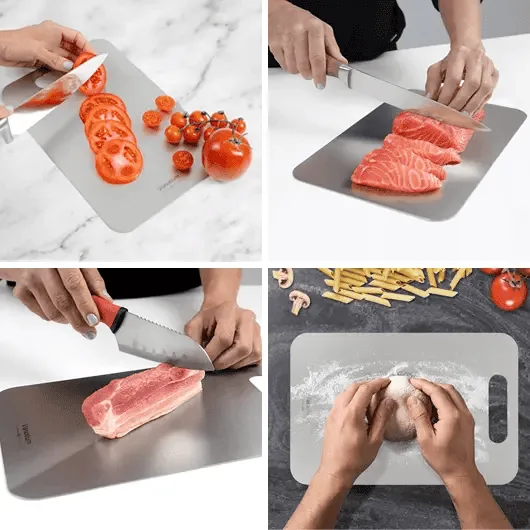
- Doesn't absorb water, so it can't warp, swell or crack.
- Resists deep grooves; only fine surface marks appear over time.
- Doesn't hold stains or odors.
- Handles the dishwasher and heat.
Cutting boards are one of those kitchen items most people replace without thinking. Plastic boards get grooved, stained and warped; bamboo boards crack along the glue lines; wood boards split if they're neglected. When you pay more for a titanium board, the obvious question is how long it will really last, and whether the higher price pays off.
This guide explains what makes titanium boards so durable, how they age compared with other materials, what can shorten their life, how to care for them, the signs it's time to replace any board and how the cost works out over the years.
Why does titanium last so long?
Titanium is a strong, tough, corrosion-resistant metal, which is why it's used in aircraft, medical implants and premium cookware. As a cutting surface, it has three big durability advantages. First, it doesn't absorb water, so it can't swell, warp or crack the way wood and bamboo can. Second, it doesn't get carved by the knife like plastic does; fine marks may appear, but they don't deepen into grooves. Third, it doesn't react with food, acids or detergents in normal kitchen use. See is titanium food safe?
How do lifespans compare?
| Board | Typical lifespan with daily use | Main reason for replacement |
|---|---|---|
| Plastic | About 1–2 years | Deep grooves, stains, warping |
| Bamboo | A few years | Cracks, splits, glue failure, warping |
| Wood | Many years with oiling | Cracks, warping, deep marks, odors |
| Glass | Until it chips or breaks | Breakage, chips |
| Titanium | Many years | Rarely: severe damage or misuse |
The USDA Food Safety and Inspection Service advises replacing cutting boards once they become excessively worn or develop hard-to-clean grooves, which is why plastic boards turn over so quickly. See when to replace a cutting board.
How does a titanium board age?
After months of daily use, a titanium board usually shows a fine pattern of light surface marks where you cut most often, visible mostly in bright light. Many people find it develops a soft, brushed look, like well-used stainless steel. What it doesn't do is develop deep, fuzzy grooves, stains from beets and turmeric, lingering garlic smells, warps from the dishwasher or cracks from drying. It stays flat and non-porous. See does a titanium cutting board scratch?
What can shorten its life?
- Cleavers and bone chopping: heavy impacts can dent or mark any board.
- Serrated knives: they saw rather than slice and leave more marks.
- Using it as a hammer or prying surface.
- Dropping it on hard floors repeatedly, which can bend edges.
- Abrasive scouring powders and steel wool, which dull the finish.
None of these is common in normal home cooking, and avoiding them keeps a titanium board in great shape.
How do you care for it so it lasts?
- Rinse or wash after every use, by hand or in the dishwasher.
- Dry it to prevent water spots, especially with hard water.
- Use a slicing or rocking motion rather than hard chopping.
- Hone your knives regularly so they glide instead of digging.
- Store it upright or flat, away from heavy metal tools.
- Remove spots occasionally with a cloth and diluted white vinegar.
That's it: no oiling, no sanding, no conditioning. See how to clean a titanium cutting board.
Does a long-lasting board affect your knives?
Any firm board wears knife edges gradually. Titanium is firmer than wood, so honing every week or two and sharpening a few times a year keeps edges in top shape. The board and knives both last longest when you let the blade glide in a slicing motion. See do titanium cutting boards dull knives?
When should you replace a titanium board?
Rarely. Consider replacing it if it's been badly bent or dented, if deep gouges appear from misuse that are hard to clean, or if it was a coated board and the coating has worn through to another material. Light surface marks alone are not a reason to replace it; they're cosmetic. See titanium vs titanium-coated boards.
Why do coated boards wear out faster?
Some low-cost boards are plastic or another material with a thin metallic coating. Knives can wear through the coating over time and expose the core, which may be plastic that sheds microplastics with every cut. A solid titanium cutting surface has no coating to wear through, which is a big part of why it lasts. Check what the cutting surface is made of before buying.
Which long-lasting board do we recommend?
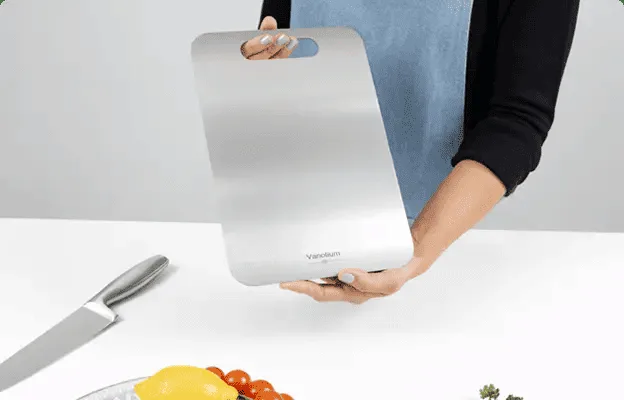
Vanotium's cutting surface is titanium with no coating to wear off. It's non-porous, sheds no plastic, doesn't hold juices, stains or odors, is waterproof and fast-drying, dishwasher-safe and designed to be scratch-resistant and warp-proof. It's heat-resistant enough to use as a trivet and light enough to handle with one hand. In October 2026 it cost $66.66 for one board, $116.66 for two, $143.31 for three or $171.08 for four ($42.77 each), with a 30-day guarantee and tracked shipping in 5–7 days. Read our Vanotium review (4.6/5).

A board built to last for years
Vanotium titanium cutting board: no coating to wear off, non-porous, dishwasher-safe and warp-proof. From $42.77 per board in multi-packs, with a 30-day guarantee.
Check today's Vanotium price →Ships in 5–7 days with tracking · 30-day guarantee
How does the cost work out over time?
| Board | Upfront | Over 5 years |
|---|---|---|
| Plastic | Low | Several replacements, plus microplastics |
| Bamboo | Low | Likely one or two replacements, plus oil |
| Wood | Medium to high | Ongoing oil and care |
| Titanium | Higher | Usually no replacement, no consumables |
If you cook every day, a titanium board used for five years costs only a few cents per day. See are titanium cutting boards worth it?
Is a long-lasting board better for the planet?
Usually, yes. Every plastic board thrown away adds to landfill, and plastic boards shed microplastics while in use: a 2023 study in Environmental Science & Technology estimated tens of grams per person per year from chopping on plastic. A board that lasts many years reduces both waste and plastic exposure. See plastic boards and microplastics.
What are the signs any board should be replaced?
- Deep grooves or cuts that hold food or stay stained.
- Cracks, splits or separating layers.
- Warping that makes it rock on the counter.
- Persistent odors after washing.
- Chips in glass boards.
- A coating that's wearing through.
How many boards should you have?
Two is ideal: one for raw meat, poultry and fish, and one for ready-to-eat foods. With two boards sharing the work, each one lasts even longer. Multi-packs make that easy and lower the price per board. See color-coded cutting boards.
Can a titanium board become a long-term kitchen staple?
That's the idea. Like a good cast iron pan or stainless steel pot, a solid titanium board is the kind of tool you buy once and keep using. It doesn't need refinishing, it doesn't fall apart, and it keeps doing the same job for years. That reliability is a big part of why many cooks consider it worth the upfront price.
Which lifespan myths can you ignore?
- "Metal boards dent easily." Normal slicing doesn't dent titanium; cleavers and heavy impacts are the exception.
- "Scratches mean it's wearing out." Fine marks are cosmetic; the surface stays non-porous.
- "The dishwasher will ruin it." Solid titanium is dishwasher-safe.
- "All titanium boards last the same." Coated boards can wear through; solid titanium surfaces don't.
How do titanium boards hold up to heavy use?
Cooks who prep every day, batch cook on weekends or cut large amounts of vegetables put boards under far more stress than occasional users. Titanium handles that kind of use well because the main wear mechanisms of other boards, water absorption, grooving and cracking, don't apply. You'll see more surface marks in the zones where you cut most, but the board stays flat and hygienic. Rotating where you cut and using both sides, if your board allows it, spreads wear even more evenly.
Does storage affect lifespan?
A little. Store the board where it won't be banged by heavy pots or knives, either upright in a rack, flat in a drawer or hanging on a hook. Avoid stacking cast iron pans on top of it. Unlike wood, titanium doesn't need air on both sides to avoid warping, so a drawer works fine.
What does "many years" look like in practice?
With normal home use, a solid titanium board should outlast several generations of plastic boards. The main signs of age are cosmetic: a soft pattern of fine marks and, in hard-water areas, occasional spots that wipe off. Functionally, it keeps doing the same job year after year.
The bottom line
A solid titanium cutting board can last many years because it doesn't absorb water, warp, crack, stain or develop deep grooves. Avoid cleavers and serrated knives, dry it after washing and hone your knives, and it will keep working long after plastic and bamboo boards would have been replaced. Make sure the cutting surface is solid titanium, not a coating.
For a board built to last, our pick is Vanotium. Check today's Vanotium price and multi-pack deals.
Sources
- USDA Food Safety and Inspection Service. Cutting Boards and Food Safety.
- Yadav H. et al. Cutting Boards: An Overlooked Source of Microplastics in Human Food? Environmental Science & Technology, 2023.
Frequently asked questions
How long does a titanium cutting board last?
With normal home use, many years, because it doesn't warp, crack or develop deep grooves.
Does titanium wear out?
Light surface marks appear, but solid titanium doesn't wear through.
How long do plastic boards last?
Often a year or two before grooves get deep.
Does a titanium board need maintenance?
Just washing; no oiling or sanding.
Is a titanium board worth it long term?
Its long life lowers the cost per year compared with boards you replace often.
Do coated boards last as long?
No. Coatings can wear through over time.

Michelle Hert
Michelle is a home cook who cooks for a family every day and spends a lot of her free time reading the research behind the products that end up in our kitchens. She started Less Plastic Kitchen after the 2023 cutting board study made her look twice at the scratched plastic board on her own counter. Her guides are built on published studies, manufacturer specifications and verified buyer feedback, and she updates them when new information comes out. More about Michelle.