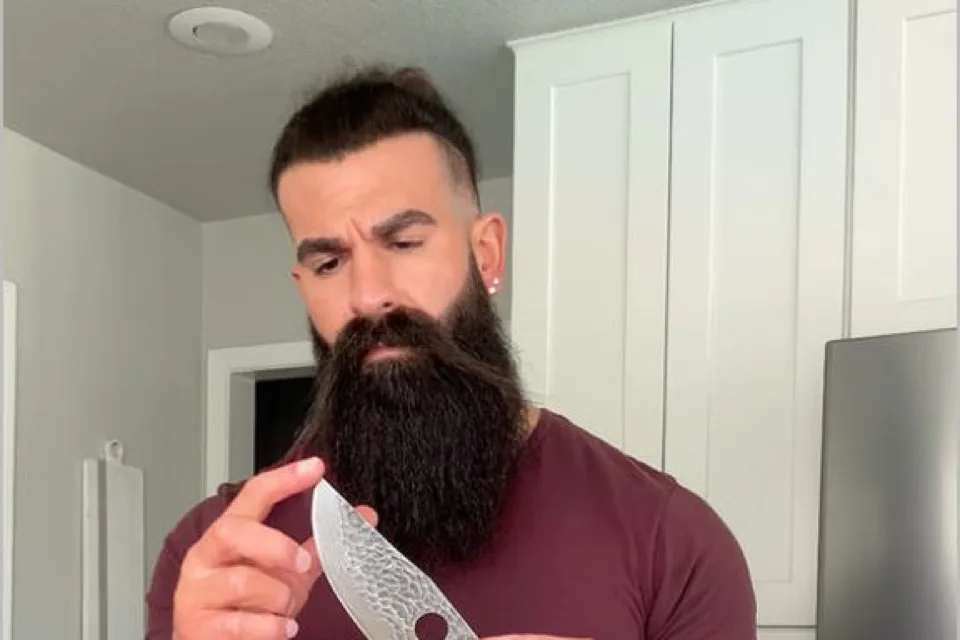
- Steel hardness: roughly 56 to 62 HRC. Kitchen knife steel is harder than the titanium used for boards, so the board doesn't chip the edge.
- Edge: a fine edge (about 12 to 15 degrees) glides through food with less pressure on the board.
- Style: a chef knife or santoku for most tasks; a serrated knife for bread.
- Avoid: chopping straight down hard, and dragging the edge sideways across the surface.
You've made the switch to a titanium cutting board to get rid of plastic particles and stubborn odors. Now a new question comes up: which knife works best on it, and will your knives stay sharp? The good news is that titanium is far kinder to edges than glass, stone or ceramic, and with the right knife and a couple of simple habits, your knives will stay sharp for a long time. This guide explains what matters in a knife for a titanium board, which styles work best, the cutting habits that protect your edge and our top recommendation.
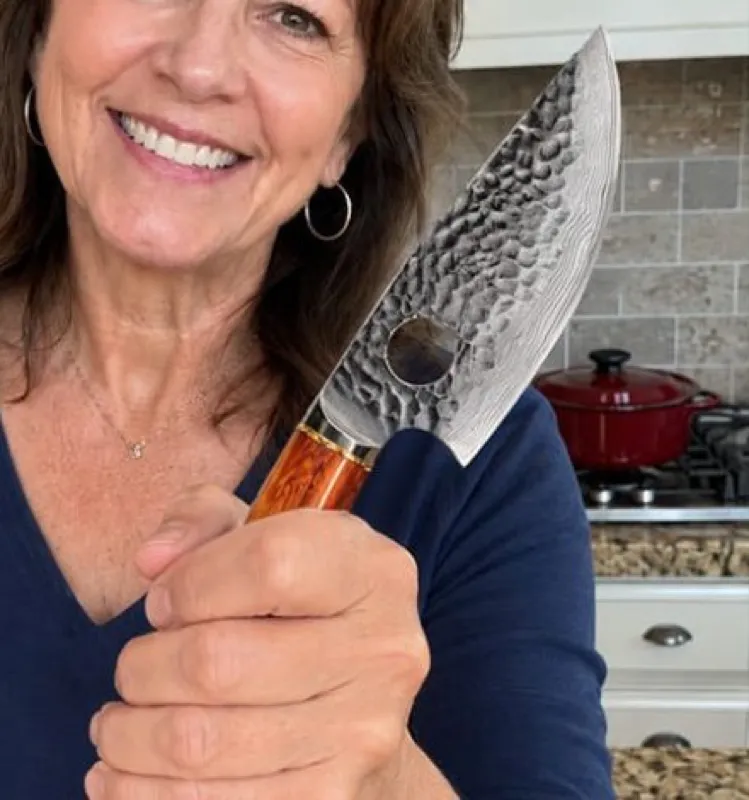
Pair it with: the Matsato Osuren chef knife
Hammered Japanese-style steel blade with a 12° edge, a finger hole for control and a pakka and acacia wood handle. $29.95 for one, or $19.98 each in the 4-pack.
Check today's Matsato price →60-day money-back guarantee · free recipe book with your order
Why does knife hardness matter on a titanium board?
Every cut is a meeting between two materials. If the board is harder than the knife, the edge rolls or chips; if the knife is harder than the board, the board gives way slightly and the edge stays intact longer. Kitchen knife steel is typically hardened to about 55 to 62 on the Rockwell C scale, which puts it above the titanium used in cutting boards. That's why a titanium board is classed as knife-friendly, unlike glass and stone. We go through the numbers in do titanium cutting boards dull knives?
What should you look for in a knife for a titanium board?
| Feature | What to look for | Why it matters |
|---|---|---|
| Steel | Hardened stainless or Japanese-style steel | Holds a fine edge longer |
| Edge angle | About 12–15° | Cuts with less force, less impact on the board |
| Blade shape | Chef or santoku | Smooth slicing and rocking motions |
| Grip | Secure handle, ideally with a pinch-grip aid | Control means fewer hard chops |
| Handle material | Wood or composite | Comfort, and less plastic in the kitchen |
Why is the Matsato Osuren a great match for titanium boards?
The Matsato Osuren is a Japanese-style chef knife with a hammered, Damascus-pattern blade, an edge ground to about 12 degrees, a finger hole near the heel and a pakka and acacia wood handle. Each feature works in your favor on a titanium board:
- The keen 12° edge slices through tomatoes, herbs and onions with very little downward pressure, so the edge isn't pounded into the board.
- The finger hole gives a stable pinch grip, which encourages controlled slicing instead of hacking.
- The hammered surface helps food release, so you don't scrape the edge sideways to clear the blade.
- The wooden handle fits a kitchen that's cutting back on plastic.
It costs $29.95 for one, $49.94 for two, $65.94 for three or $79.92 for four ($19.98 each), with a 60-day money-back guarantee. Read our full Matsato Osuren review.
The knife we pair with a titanium board
Matsato Osuren: hammered Japanese-style blade, 12° edge and finger hole. From $19.98 per knife in bundles, with a 60-day money-back guarantee.
Check today's Matsato price →60-day money-back guarantee · free recipe book with your order
Which knife styles work best on titanium?
- Chef knife: the all-rounder for chopping, slicing and rocking through herbs.
- Santoku: a flatter edge that suits push-cutting vegetables.
- Paring knife: small jobs like trimming and peeling.
- Serrated bread knife: saws through crusts without pressure; serrations are very forgiving on any board.
- Carving knife: long, smooth strokes for roasts and turkey.
Cleavers used for chopping through bones are better on a thick wooden block, since repeated heavy strikes stress any edge.
How should you cut on a titanium board?
- Slice, don't chop. Use a forward or rocking motion so the edge glides rather than hammers.
- Let the knife do the work. A sharp edge needs little pressure.
- Scrape with the spine. Move chopped food with the back of the blade, never the edge.
- Don't twist the tip into the board to pry or lift food.
- Use a non-slip mat or damp towel if your board moves; see how to stop a cutting board slipping.
How often should you hone and sharpen?
On any board, the edge slowly bends out of alignment with use. A few light strokes per side on a honing rod every week or two straighten it again. Sharpening, which actually removes metal to create a new edge, is only needed a few times a year for most home cooks. Honing regularly is the single best habit for keeping a knife sharp on a titanium board.
Which knives and habits should you avoid?
- Very soft, cheap knives that lose their edge quickly on any surface.
- Ceramic knives, which are hard but brittle and can chip if they strike a hard board at an angle.
- Chopping frozen food or bones with a thin chef knife.
- Putting knives in the dishwasher, which dulls edges and damages handles.
- Using the edge to scrape food off the board.
How does titanium compare with other boards for knife care?
| Board | Kindness to edges | Hygiene | Microplastics |
|---|---|---|---|
| End-grain wood | Very gentle | Good with care | None |
| Titanium | Gentle | Excellent, non-porous | None |
| Plastic | Gentle | Grooves trap bacteria | Sheds particles |
| Glass, stone | Very hard on edges | Easy to clean | None |
Titanium gives you most of the knife-friendliness of wood with the easy, non-porous cleaning of glass, and none of the plastic shedding. Compare more in stainless steel vs titanium cutting boards and titanium vs wood.
Which titanium board do we recommend?
Our pick is Vanotium: a titanium-surface board that's non-porous, dishwasher-safe and doesn't shed plastic, from $42.77 per board in the 4-pack with a 30-day money-back guarantee. See our Vanotium review.

Complete the set with a Vanotium board
Titanium surface, knife-friendly, non-porous and dishwasher-safe. From $42.77 per board, with a 30-day money-back guarantee.
Check today's Vanotium price →Ships in 5–7 days with tracking · 30-day guarantee
Do a knife and titanium board make a good gift?
Yes. A sharp knife and a modern titanium board are one of the most useful gifts for anyone who cooks, and they look great unwrapped together. Bundles of both bring the price per item down, so you can keep a set and give one. More ideas in gifts for home cooks.
How do you care for the knife and board together?
- Wash the knife by hand and dry it right away.
- Wash the titanium board with hot soapy water or in the dishwasher.
- Store the knife on a magnetic strip or in a block, never loose in a drawer.
- Store the board upright so it dries completely.
- Hone the knife every week or two.
Should you use separate boards for meat and vegetables?
Yes. The USDA recommends using one cutting board for fresh produce and bread and a separate one for raw meat, poultry and seafood, to prevent cross-contamination. With two non-porous titanium boards, switching tasks is quick: rinse the knife, move to the other board and keep cooking. It also means your knife isn't sitting on a board that needs a deep clean before you can slice the next ingredient. Our guide to the best cutting board for raw meat explains the setup.
How can you tell when your knife needs attention?
- Tomato skins resist the first touch of the blade instead of splitting instantly.
- Onions crunch and slide rather than slicing cleanly.
- You notice yourself pressing harder than usual.
- Herbs look bruised or dark at the cut edges.
- The knife slips off the skin of a pepper.
Try honing first. If a few strokes don't bring the edge back, it's time to sharpen.
How should you store knives so they stay sharp?
Storage matters as much as the board. Knives tossed loose in a drawer bang against other utensils and lose their edge quickly, and they're a hazard for fingers. A magnetic wall strip keeps blades separate and visible; a wooden block works well too, as long as you slide knives in spine-first so the edge doesn't drag. For drawer storage, use an in-drawer knife organizer or a blade guard for each knife.
Is a very sharp knife safe for everyday cooks?
A sharp knife is actually safer than a dull one, because it goes where you guide it instead of slipping. Use the claw grip, keep the board steady, cut away from your body and never try to catch a falling knife. Keep sharp knives out of reach of young children.
How much should you spend on a chef knife?
You don't need a $200 knife for a titanium board. What matters most is a hard, well-ground edge and a handle that feels secure in your hand. A mid-priced Japanese-style knife like the Matsato Osuren, especially in a multi-pack where the price drops to about $20 per knife, gives you a keen edge and a wooden handle at a fraction of boutique prices. Spend the difference on a honing rod and a second board.
What's the bottom line?
The best knife for a titanium cutting board is a sharp, hardened-steel chef knife used with a slicing motion and honed regularly. Because knife steel is harder than board titanium, your edge stays intact far longer than on glass or stone. The Matsato Osuren, with its 12° edge, finger hole and wooden handle, is an excellent, affordable match, and paired with a Vanotium board it makes a plastic-free prep setup that's easy to clean and kind to your knives.
Pair it with: the Matsato Osuren chef knife
Hammered Japanese-style steel blade with a 12° edge, a finger hole for control and a pakka and acacia wood handle. $29.95 for one, or $19.98 each in the 4-pack.
Check today's Matsato price →60-day money-back guarantee · free recipe book with your order
Frequently asked questions
Do titanium cutting boards ruin knives?
No. Kitchen knife steel is harder than the titanium used for boards, so the board gives way, not the edge.
What knife is best for a titanium board?
A sharp, hardened-steel chef knife or santoku with a fine edge, used with a slicing motion.
Can I use a ceramic knife on titanium?
It's possible, but ceramic is brittle and can chip; steel knives are a safer choice.
How often should I hone my knife on a titanium board?
A few light strokes on a honing rod every week or two.
Is the Matsato Osuren good on titanium boards?
Yes. Its 12-degree edge and finger hole encourage controlled slicing that's gentle on the edge.
Is titanium better for knives than glass?
Yes, by a wide margin. Glass dulls edges quickly; titanium is knife-friendly.

Michelle Hert
Michelle is a home cook who cooks for a family every day and spends a lot of her free time reading the research behind the products that end up in our kitchens. She started Less Plastic Kitchen after the 2023 cutting board study made her look twice at the scratched plastic board on her own counter. Her guides are built on published studies, manufacturer specifications and verified buyer feedback, and she updates them when new information comes out. More about Michelle.