- A non-porous surface that doesn't absorb juices, like titanium or glass.
- No deep grooves where bacteria and food residue can hide.
- Easy, thorough cleaning, ideally dishwasher-safe.
- Separate boards for raw meat and ready-to-eat foods.
"Antibacterial cutting board" is a popular search, and it's easy to see why. Raw chicken, beef and fish can carry bacteria like Salmonella, E. coli and Campylobacter, and nobody wants those spreading to salad or bread. Manufacturers have responded with boards marketed as antibacterial or antimicrobial. But what does that label really mean, and is it the best way to keep your board safe?
This guide explains what antibacterial boards are, why surface and cleaning matter more than additives, which materials are easiest to keep hygienic, how to clean and sanitize boards properly and how to avoid cross-contamination.
What does "antibacterial" mean on a cutting board?
Most boards sold as antibacterial are made of plastic with an antimicrobial agent added to the material, often silver-based compounds or other additives meant to slow bacterial growth on the surface. Some wood and bamboo boards are marketed as "naturally antibacterial" because of properties of the material. These labels describe the material itself, not the result of real-world use. Food residue, scratches and how you clean the board matter much more than any additive.
Why isn't an antibacterial label enough?
- It doesn't clean the board. Food residue still needs to be washed away.
- It doesn't fill grooves. Knife scars in plastic still trap moisture and debris.
- It doesn't make raw meat safe for the next food you cut.
- Additives can wear off or be less effective on a scratched surface.
The USDA Food Safety and Inspection Service recommends washing cutting boards with hot, soapy water after each use, sanitizing them and replacing boards that have become excessively worn or have hard-to-clean grooves, whatever the board is made of.
Which materials are easiest to keep hygienic?
| Material | Porous? | Grooves over time? | Dishwasher? |
|---|---|---|---|
| Titanium | No | Fine marks only | Yes |
| Glass | No | No, but chips and dulls knives | Usually |
| Stainless steel | No | Fine marks | Usually |
| "Antibacterial" plastic | Surface becomes rough | Yes | Often |
| Plastic | Surface becomes rough | Yes | Often |
| Wood | Yes | Yes | No |
| Bamboo | Yes | Yes | No |
See the best non-toxic cutting board.
Why do grooves matter so much?
A new plastic board looks smooth, but after a few months of daily use it's covered in knife scars. Those cuts hold moisture, food particles and fat, and they're hard to clean even in the dishwasher. That's where bacteria can survive. An antimicrobial additive doesn't change that. A hard, non-porous surface that doesn't get carved by the knife avoids the problem in the first place. See cutting board scratches and bacteria.
What about microplastics from antibacterial plastic boards?
An antibacterial plastic board is still a plastic board. A 2023 study in Environmental Science & Technology estimated that chopping on plastic boards can release tens of grams of microplastics per person per year. If you're trying to cut plastic from your kitchen, an additive-treated plastic board doesn't solve that. See plastic boards and microplastics.
How do you clean and sanitize a cutting board properly?
- Scrape off food right after use.
- Wash with hot, soapy water and a brush or sponge, both sides.
- Rinse thoroughly.
- Sanitize after raw meat: run non-porous boards through a hot dishwasher cycle, or use a diluted bleach solution or food-safe sanitizer as directed on the label, then rinse if required.
- Dry completely before storing.
See how to sanitize a cutting board.
How do you prevent cross-contamination?
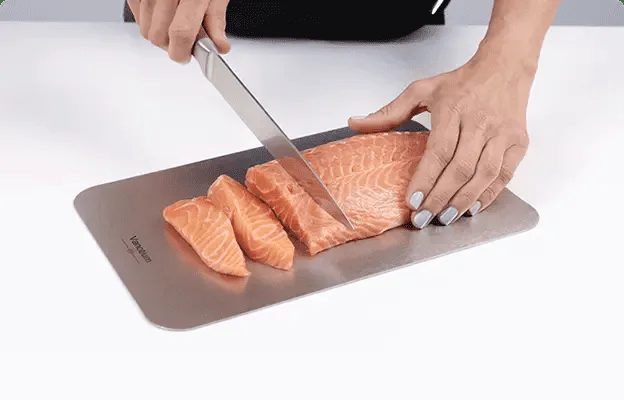
- Use separate boards for raw meat, poultry and fish and for ready-to-eat foods.
- If you only have one board, cut produce and bread first, then raw meat, and wash thoroughly.
- Wash knives and hands after handling raw meat.
- Don't rinse raw chicken in the sink, which spreads splashes.
- Keep raw meat on the bottom shelf of the fridge.
The FDA lists "separate" as one of its four core food safety steps, along with clean, cook and chill. See color-coded cutting boards.
Which hygienic board do we recommend?
Vanotium is a titanium cutting board with a non-porous surface that doesn't absorb juices, stains or odors and sheds no plastic. It's dishwasher-safe, designed to be scratch-resistant and warp-proof, waterproof and fast-drying, which makes it easy to keep truly clean after raw meat and fish. In October 2026 it cost $66.66 for one, $116.66 for two (one for raw, one for produce) or $42.77 each in a four-pack, with a 30-day guarantee. Read our Vanotium review (4.6/5) and are titanium boards safe?

Hygiene without plastic or additives
Vanotium titanium cutting board: non-porous, dishwasher-safe and plastic-free. From $42.77 per board in multi-packs, with a 30-day guarantee.
Check today's Vanotium price →Ships in 5–7 days with tracking · 30-day guarantee
Are wood and bamboo naturally antibacterial?
Some research has looked at how certain woods interact with bacteria, and well-maintained hardwood boards can perform reasonably well. But wood and bamboo are porous, need hand washing and oiling, and become harder to clean as they crack or get deeply cut. "Naturally antibacterial" doesn't mean you can skip careful cleaning, especially after raw meat. See wood vs plastic and bamboo pros and cons.
When should you replace a board for hygiene reasons?
- Deep grooves you can't clean.
- Persistent stains or odors after washing.
- Cracks, splits or separated layers.
- Warping that leaves gaps under the board.
See when to replace a cutting board.
What's the safest way to cut raw chicken?
Use a dedicated non-porous board, keep the chicken in its packaging until you're ready, cut it, then put the board and knife straight into the dishwasher or wash them in hot, soapy water. Wipe the counter with a sanitizer and wash your hands. Cook chicken to a safe internal temperature. See the best board for raw meat.
What else keeps the kitchen hygienic?
- Replace or sanitize dish sponges often; they hold more bacteria than most boards.
- Wash dish towels frequently.
- Clean sink drains and faucet handles.
- Use a food thermometer for meat.
- Refrigerate leftovers within two hours.
Which antibacterial myths can you ignore?
- "Antibacterial boards don't need washing." They do, every time.
- "Natural boards kill all germs." They still need careful cleaning.
- "A board that looks clean is clean." Grooves can hide residue.
- "One board is fine if you rinse it." Rinsing isn't washing; use separate boards or wash thoroughly.
What's the best choice for families?
For families, simplicity is key: two non-porous, dishwasher-safe boards, one for raw meat and one for everything else, plus good handwashing habits. That's more effective than any special coating and easy for everyone in the house to follow.
Do silver-treated boards work?
Silver and other antimicrobial additives are designed to slow the growth of some microbes on the material's surface. Lab tests of treated materials don't always reflect what happens in a real kitchen, where food residue, fat and knife scars cover the surface. Treated boards can still be useful plastic boards, but they don't replace hot, soapy water, sanitizing after raw meat and replacing boards when they're worn. If your goal is less plastic, a treated plastic board is still plastic.
Is your sponge the real problem?
Often, yes. Kitchen sponges stay damp and collect food particles, which makes them one of the most bacteria-rich items in the house. Wiping a board with a dirty sponge can undo good habits. Replace sponges frequently, let them dry between uses, or use a brush that dries quickly. Dishwashing brushes and the dishwasher itself are more hygienic options for cutting boards.
How do you clean the counter around the board?
After cutting raw meat, wipe the counter with hot, soapy water and then a kitchen disinfectant used as directed on the label. Pay attention to the area under and around the board, where juices can run. Wash your hands before touching other food, utensils or the fridge door.
Does a board that smells clean mean it is clean?
Not necessarily. A board can smell fine and still have residue in its grooves, and some boards absorb odors that hang around even when they're clean. A non-porous board that doesn't absorb smells and is washed or run through the dishwasher after each use is the most reliable approach.
Does vinegar disinfect a cutting board?
Vinegar can help remove odors and light residue, but it isn't a substitute for hot, soapy washing, and it's not as reliable a sanitizer as products made for that purpose. After raw meat, use the dishwasher or a food-safe sanitizer as directed.
Where should you store boards between uses?
Store boards dry, upright or flat, in a clean spot away from raw meat packaging and the trash. Damp, stacked boards in a closed cabinet stay wet longer.
The bottom line
An antibacterial label doesn't make a cutting board safe on its own. What matters is a non-porous surface without deep grooves, thorough cleaning after every use, sanitizing after raw meat and separate boards for raw and ready-to-eat foods. A dishwasher-safe titanium board delivers that without plastic or chemical additives.
For a hygienic, plastic-free board, our pick is Vanotium. Check today's Vanotium price and multi-pack deals.
Sources
- USDA Food Safety and Inspection Service. Cutting Boards and Food Safety.
- U.S. Food and Drug Administration. Safe Food Handling.
- Yadav H. et al. Cutting Boards: An Overlooked Source of Microplastics in Human Food? Environmental Science & Technology, 2023.
Frequently asked questions
Do antibacterial cutting boards work?
Treated boards don't replace proper washing. A non-porous, easy-to-clean board plus hot soapy water matters more.
What is the most hygienic cutting board?
Non-porous, dishwasher-safe boards such as titanium are easy to keep clean.
Are wooden boards antibacterial?
Some research suggests wood can be hygienic when dried properly, but it needs hand care.
How should I clean a board after raw meat?
Wash with hot soapy water, rinse and dry, or use the dishwasher if the board allows.
Do scratches hold bacteria?
Deep grooves in plastic can trap residue and be harder to clean.
Should I use bleach on my board?
A diluted bleach solution can sanitize; follow USDA guidance and rinse well.

Michelle Hert
Michelle is a home cook who cooks for a family every day and spends a lot of her free time reading the research behind the products that end up in our kitchens. She started Less Plastic Kitchen after the 2023 cutting board study made her look twice at the scratched plastic board on her own counter. Her guides are built on published studies, manufacturer specifications and verified buyer feedback, and she updates them when new information comes out. More about Michelle.