
- Red: raw meat.
- Yellow: raw poultry.
- Blue: raw fish and seafood.
- Green: fruits and vegetables.
- Brown: cooked meats.
- White: dairy, bread and general use.
If you've ever worked in a restaurant kitchen, you've probably seen a rack of brightly colored cutting boards, each reserved for a different food. The idea is simple: never cut raw chicken and then a salad on the same board without cleaning it, because bacteria from raw meat can end up in food that won't be cooked.
Color-coded boards are popular at home too, but most sets are made of plastic, which raises its own concerns about microplastics. This guide explains the color system, why separating boards matters, how to set up a simple home system, plastic-free alternatives and how to clean and sanitize each board.
Why use separate cutting boards?
Raw meat, poultry and seafood can carry bacteria like Salmonella, E. coli and Campylobacter. When the same board is used for raw meat and then for foods eaten raw, like salad, fruit or bread, those bacteria can spread. The USDA Food Safety and Inspection Service recommends using one cutting board for fresh produce and bread and a separate one for raw meat, poultry and seafood. The FDA lists "separate" as one of the four key steps to food safety, along with clean, cook and chill.
What do the cutting board colors mean?
| Color | Use |
|---|---|
| Red | Raw red meat |
| Yellow | Raw poultry |
| Blue | Raw fish and seafood |
| Green | Fruits, vegetables and salad |
| Brown | Cooked meats |
| White | Dairy, bread and general use |
| Purple | Allergen-free food (in some kitchens) |
This system is widely used in professional kitchens, though it isn't a legal standard everywhere. At home, you don't need six boards; two or three well-separated boards do the job.
What's a simple system for home cooks?
- Board 1: raw proteins, meat, poultry and fish.
- Board 2: ready-to-eat foods, produce, bread, cheese and cooked foods.
- Optional board 3: strong flavors like onion and garlic, or a large carving board for roasts.
Keep them visibly different: different colors, materials, sizes or labels. What matters most is that everyone in the household knows which is which.
What's the problem with plastic color-coded boards?
Plastic boards are inexpensive and come in every color, which is why they dominate color-coded sets. But they have two downsides. First, knife scars build up quickly and become hard to clean, so the USDA recommends replacing boards once they develop hard-to-clean grooves. Second, a 2023 study in Environmental Science & Technology found that chopping on plastic boards releases microplastics with each cut, potentially adding up to tens of grams per person per year. See plastic boards and microplastics and cutting board scratches and bacteria.
How can you separate boards without plastic?
- Use different materials: titanium for raw proteins, wood for bread and produce.
- Use two boards of the same material with a small label, engraving or silicone corner tab.
- Use different sizes: a large board for meat, a smaller one for produce.
- Store them in separate places so they don't get mixed up.
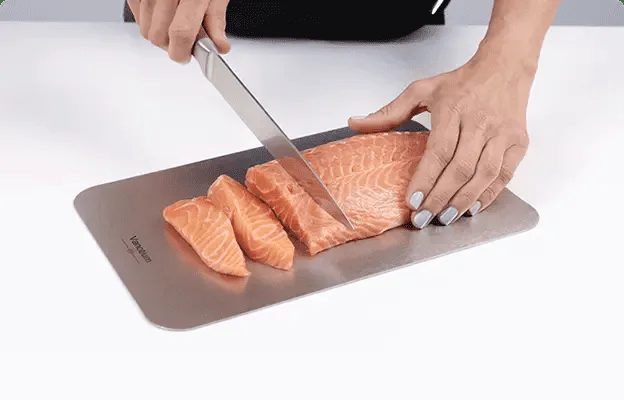
Why is titanium a good choice for raw meat?
For raw proteins, a non-porous surface is ideal: juices stay on top, wash off easily and don't soak into the board. Vanotium is a titanium cutting board with a non-porous surface that sheds no plastic, resists stains and odors, is dishwasher-safe and resists scratches and warping, so it doesn't develop the deep grooves that make plastic boards hard to clean. Many cooks buy two: one for raw meat and fish, one for everything else. In October 2026 it was $66.66 for one board, $116.66 for two or $42.77 each in a four-pack, with a 30-day guarantee. Read our Vanotium review (4.6/5) and the best board for raw meat.

Separate boards, no plastic
Vanotium titanium cutting board: non-porous, dishwasher-safe and sheds no plastic. Two-board and four-pack deals bring it down to $42.77 per board, with a 30-day guarantee.
Check today's Vanotium price →Ships in 5–7 days with tracking · 30-day guarantee
How do you clean and sanitize each board?
| Board | After raw meat | Daily care |
|---|---|---|
| Titanium | Hot soapy water or dishwasher; sanitize if desired | Rinse, dry |
| Plastic | Dishwasher or hot soapy water; sanitize | Replace when grooved |
| Wood | Hot soapy water, dry upright; sanitize with diluted vinegar or a mild bleach solution, rinse | Oil monthly; no dishwasher |
See how to sanitize a cutting board and how to clean a titanium board.
Which habits prevent cross-contamination?
- Cut produce and ready-to-eat food first, then raw meat, if you must use one board, and wash it thoroughly between.
- Wash knives between raw meat and other foods.
- Wash hands after handling raw meat.
- Don't rinse raw chicken in the sink.
- Keep raw meat on the bottom shelf of the fridge.
What about food allergies?
If someone in your household has a serious food allergy, a dedicated board and knife for allergen-free food (sometimes purple in professional kitchens) adds an extra layer of protection. Wash it separately and store it apart.
How many boards do you really need?
For most homes, two boards are enough: one for raw proteins and one for everything else. Add a third if you cook a lot of bread, cheese or onions and garlic, or want a large carving board for holidays. More boards mean more storage, so choose durable ones you'll actually use. See cutting board size guide.
What's the easiest way to label boards?
If your boards look alike, mark them so no one has to guess. Options include a small engraving on a corner, a silicone corner tab in a color, a dot of food-safe paint on the edge, or simply storing the raw-meat board in a different spot, like on its own hook. Some families use one side of a double-sided board for raw meat and the other for produce, but separate boards are safer when several people cook. Whatever system you choose, explain it once to everyone who uses the kitchen.
Do restaurants really follow the color system?
Many professional kitchens do, because it's a quick visual way to keep busy staff from mixing boards. Health inspectors look for practices that prevent cross-contamination, and color coding is one of the most common. At home, you don't need the full six-color system, but borrowing the main principle, separate boards for raw proteins and ready-to-eat foods, gives you the same core benefit.
Does the board material matter as much as the color?
Yes. Color only tells you which food goes on a board; the material decides how easy it is to keep clean. Porous materials like wood can absorb juices, and soft plastic develops knife grooves that trap residue. Non-porous, hard surfaces wash clean more easily. The USDA notes that both wood and plastic boards should be replaced once they develop excessive wear or deep grooves. That's why many home cooks now choose a non-porous board for raw proteins and keep a wood board for bread and produce, using the material itself as the "color code."
How do you handle big holiday meals?
Holidays mean raw turkey, roasts, vegetables, bread and desserts all being prepared at once, often by several people. That's when cross-contamination is most likely. Set up a clear system before cooking starts: one board and knife only for raw poultry or meat, a second board for vegetables and salads, and a large carving board for the cooked roast. Wash the raw-meat board in hot, soapy water or the dishwasher right after use, and keep a clean towel for wiping hands. See carving boards for turkey.
What are the most common mistakes?
- Putting cooked meat back on the board that held it raw.
- Using the same knife for raw chicken and salad without washing it.
- Wiping a board with a cloth instead of washing it.
- Keeping deeply grooved plastic boards long past their prime.
- Drying boards flat, which traps moisture underneath.
How do you teach kids the system?
Colors make it easy: "the red board is only for raw meat." For older kids helping in the kitchen, explain why: raw meat can carry germs that cooking kills, but salad and fruit aren't cooked. Let them be in charge of the produce board, which keeps them away from raw meat.
How should you store several boards?
Store boards upright in a rack or on their edge so air reaches both sides and they dry completely. Keep the raw-meat board in its own slot or on a separate hook, so it's never grabbed by mistake for slicing bread or fruit. If space is tight, a slim vertical organizer inside a cabinet keeps two or three boards tidy and separated.
The bottom line
Color-coded cutting boards are a simple way to keep raw meat, poultry and fish away from foods that won't be cooked. At home, the essential rule is one board for raw proteins and another for ready-to-eat foods. If you want to avoid plastic boards and their microplastics, separate boards by material, size or label, with a non-porous titanium board for raw meat.
For a plastic-free raw-meat board, our pick is Vanotium. Check today's Vanotium price and multi-pack deals.
Sources
- USDA Food Safety and Inspection Service. Cutting Boards and Food Safety.
- U.S. Food and Drug Administration. Safe Food Handling.
- Yadav H. et al. Cutting Boards: An Overlooked Source of Microplastics in Human Food? Environmental Science & Technology, 2023.
Frequently asked questions
What color cutting board is for raw meat?
Red is used for raw red meat, yellow for raw poultry and blue for raw fish in the common professional system.
What color cutting board is for vegetables?
Green is the usual color for fruits, vegetables and salads.
Do I need color-coded boards at home?
Not necessarily. Two clearly different boards, one for raw proteins and one for ready-to-eat food, cover most homes.
Are plastic color-coded boards safe?
They work for separation, but they groove quickly and shed microplastics as you cut.
What's a plastic-free way to separate boards?
Use different materials, sizes or labels, for example a titanium board for raw meat and a wood board for bread.
Can a titanium board be used for raw meat?
Yes. A non-porous, dishwasher-safe titanium board like Vanotium is a good choice for raw meat and fish.

Michelle Hert
Michelle is a home cook who cooks for a family every day and spends a lot of her free time reading the research behind the products that end up in our kitchens. She started Less Plastic Kitchen after the 2023 cutting board study made her look twice at the scratched plastic board on her own counter. Her guides are built on published studies, manufacturer specifications and verified buyer feedback, and she updates them when new information comes out. More about Michelle.