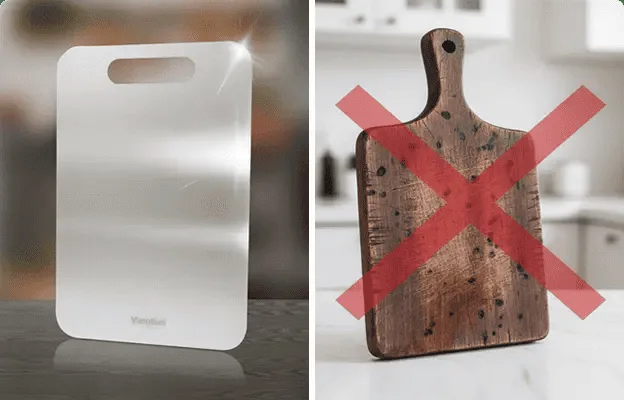
- Don't confuse titanium metal with titanium dioxide (E171), a white powder once used as a food coloring. That's a different substance, and EU authorities stopped allowing it as a food additive in 2022.
- Titanium cookware, cutting boards and bottles are used every day in kitchens around the world.
As more people swap plastic kitchen tools for metal ones, titanium keeps coming up: titanium cutting boards, titanium-coated pans, titanium water bottles, titanium chopsticks. It's natural to ask whether a metal is safe to have in contact with food every day, especially when you've heard headlines about "titanium" in food additives.
This guide explains why titanium is considered food-safe, how it compares with other kitchen metals, the important difference between titanium metal and titanium dioxide, and what to look for in titanium kitchen products.
What is titanium?
Titanium is a naturally occurring metal known for being strong, light and extremely resistant to corrosion. It's about 40% lighter than steel for the same volume, which is why it's prized in aerospace, sports equipment and outdoor gear. In everyday life, you'll also find it in eyeglass frames, watches and jewelry for sensitive skin.
Why is titanium considered food-safe?
The key is a thin, stable layer of titanium oxide that forms naturally on the surface as soon as titanium meets air. This layer protects the metal underneath and makes it highly resistant to corrosion, even with salty and acidic foods. Because titanium doesn't readily react or corrode, very little of it moves into food or the body under normal use.
That same property is why titanium is a leading material for medical implants. A review of titanium implants describes titanium and its alloys as highly biocompatible, meaning the body tolerates them well over many years. If a metal is trusted inside the body for decades, it's a reassuring sign for a cutting board or a water bottle.
Is titanium the same as titanium dioxide in food?
No, and this is the most common source of confusion. Titanium dioxide (TiO₂, labeled E171 in Europe) is a fine white powder used as a pigment. It was added to some candies, frostings and chewing gums to make them bright white. In 2021, the European Food Safety Authority concluded that E171 could no longer be considered safe as a food additive, and the EU stopped allowing it in food in 2022.
That decision was about tiny particles of a powder being eaten directly as an ingredient. It doesn't apply to solid titanium metal used in cookware, cutting boards, bottles or implants, which is a completely different form and doesn't break down into a food coloring.
| Titanium metal | Titanium dioxide (E171) | |
|---|---|---|
| Form | Solid metal | Fine white powder |
| Use | Cookware, cutting boards, bottles, implants | Food coloring, paints, sunscreen |
| Eaten as an ingredient? | No | Yes, when used in food |
| Regulatory note | Widely used in food contact and medical devices | No longer allowed as a food additive in the EU since 2022 |
How does titanium compare with other kitchen metals?
| Metal | Reactivity with food | Notes |
|---|---|---|
| Titanium | Very low | Corrosion-resistant, nickel-free, lightweight |
| Stainless steel | Low | Very common and durable; most grades contain nickel and chromium |
| Cast iron | Moderate | Can add small amounts of iron to food; acidic foods can strip seasoning |
| Aluminum (uncoated) | Higher with acidic foods | Usually anodized or coated for cookware |
| Copper (unlined) | High with acidic foods | Usually lined with tin or stainless steel |
See stainless steel vs titanium cutting boards for a closer comparison.
Is titanium good for people with metal allergies?
Titanium is often recommended for people with nickel sensitivity because pure titanium contains no nickel. That's why it's popular for earrings and watch backs for sensitive skin. Stainless steel, by contrast, usually contains nickel. If you have a known metal allergy, talk with your doctor, but titanium is widely considered one of the gentlest metals for sensitive people.
Why do surgeons and astronauts trust titanium?
Titanium's reputation comes from the places it's trusted most. Surgeons have used it for decades in hip and knee replacements, bone plates and dental implants, because the body tolerates it well and it doesn't corrode inside the body. Engineers use it in aircraft and spacecraft because it's strong, light and resists extreme conditions. Divers and sailors rely on it for parts exposed to salt water. A material chosen for those jobs has to be stable and dependable, and those same qualities are exactly what you want in something that touches your food every day.
Why is titanium popular for camping cookware?
Backpackers and campers were among the first everyday users of titanium in the kitchen. A titanium pot or mug weighs very little, handles an open flame, doesn't rust after a rainy trip and doesn't hold the taste of last night's dinner. Those same benefits translate well to the home kitchen: a light, tough, low-maintenance surface that keeps working for years. It's no surprise that the material moved from trail gear to cutting boards and bottles.
How long does titanium kitchenware last?
With normal care, a long time. Titanium doesn't rust, rot, crack from moisture or warp in the dishwasher, and its oxide layer renews itself if the surface is lightly scratched. Everyday use may leave fine marks on the brushed finish, which are cosmetic. Compared with plastic boards that are often replaced every year or two, a titanium board is built to stay in your kitchen for years. See when to replace a cutting board.
Where is titanium used in the kitchen?
- Cutting boards: non-porous, plastic-free, dishwasher-safe. See titanium cutting board pros and cons.
- Camping pots and mugs: prized for being light and tough.
- Water bottles and cups: no plastic taste, no metallic taste for most people.
- Chopsticks and utensils: light and durable.
- "Titanium" nonstick pans: careful, these are usually aluminum pans with a nonstick coating reinforced with titanium particles, not solid titanium. Check what you're buying. See is nonstick cookware safe?
Are titanium cutting boards safe?
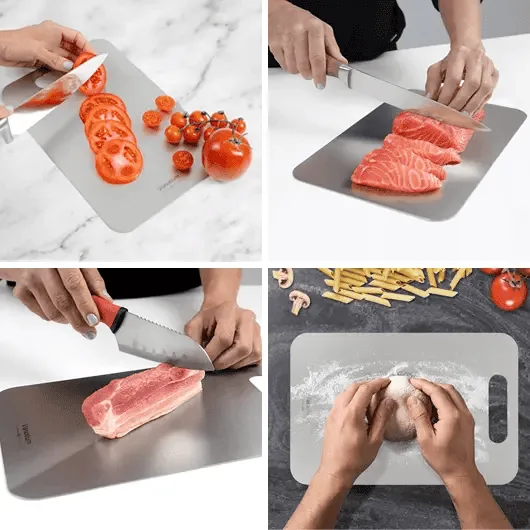
Yes, a titanium board is a safe, hygienic surface for food prep. It's non-porous, so raw meat and fish juices sit on top and wash off, and it doesn't shed microplastics like plastic boards. The main things to look for are a genuine titanium cutting surface (not a plastic board with a metallic look), clear product information, and a dishwasher-safe design. For a deeper look at the cutting board specifically, see are titanium cutting boards safe?
Why are people switching from plastic to titanium?
Mostly because of microplastics. A 2023 study in Environmental Science & Technology estimated that chopping on plastic boards releases microplastics with every cut, adding up to grams per person per year (Yadav et al., 2023). Titanium offers an inert, durable alternative that doesn't shed plastic. See plastic cutting boards and microplastics.
Which titanium board do we recommend?
Our pick is Vanotium. Its advanced titanium surface is non-porous, odor- and stain-resistant, dishwasher-safe, waterproof and fast-drying, scratch-resistant and warp-proof, heat-resistant and lightweight, with a built-in handle cut-out. On the official checkout in October 2026, one board was $66.66, with multi-packs from $42.77 per board and a 30-day guarantee. Read our Vanotium review (4.6/5).

A food-safe, plastic-free surface
Vanotium titanium cutting board: inert titanium surface, non-porous, dishwasher-safe and microplastic-free. From $42.77 per board in multi-packs, with a 30-day guarantee.
Check today's Vanotium price →Ships in 5–7 days with tracking · 30-day guarantee
Does titanium change the taste of food?
Most people notice no taste at all. Because titanium is so unreactive, it doesn't give the metallic tang some people notice with uncoated aluminum or copper, and it doesn't hold the smells of previous foods like wood or scratched plastic can. That's one reason titanium mugs and bottles are popular with coffee and tea drinkers, and why a titanium board is handy when you go from cutting garlic to slicing fruit.
Is titanium safe with heat?
Yes. Titanium has a very high melting point and handles kitchen temperatures easily. A titanium cutting board can double as a trivet for a hot pan without melting or warping, which plastic can't do. Always follow each product's instructions, especially for items with non-titanium parts like handles or lids.
How do you clean titanium kitchenware?
- Wash with hot soapy water and a soft sponge, or use the dishwasher if the product allows.
- Rinse and towel-dry to prevent water spots.
- Use baking soda paste for stubborn residue and white vinegar for mineral spots.
- Avoid steel wool and harsh abrasive powders, which scuff the finish.
See how to clean a titanium cutting board.
What should you check when buying titanium kitchen products?
- Whether the food-contact surface is actually titanium, not a coating or a plastic with a metal look.
- Clear product information from the brand.
- Care instructions, including dishwasher guidance.
- A return policy or guarantee so you can try it at home.
- Honest marketing: no medical promises, no "kills parasites" or miracle claims.
What are common myths about titanium and food?
- "Titanium in food is banned in Europe." The EU ban was on titanium dioxide powder as a food additive, not on titanium metal.
- "All metals leach into food." Titanium's stable oxide layer makes it one of the least reactive.
- "Titanium pans are solid titanium." Many are aluminum with a titanium-reinforced coating.
- "Metal boards are unhygienic because they're hard." Being non-porous makes them easier to clean.
Is titanium a good choice for families with kids?
Yes. A titanium board is light enough for older kids to carry, doesn't shatter like glass, and goes in the dishwasher, so it's easy to keep clean after messy family meals. Titanium cups and bottles are durable for lunch boxes and outdoor trips. As with any kitchen item, teach kids safe knife habits and supervise younger children.
The bottom line
Titanium metal is considered one of the safest, most inert materials for food contact, trusted in medical implants and used in cookware, bottles and cutting boards. Don't confuse it with titanium dioxide powder, a food coloring that's no longer allowed as an additive in the EU. For a plastic-free, non-porous, easy-to-clean cutting surface, titanium is an excellent choice.
Our pick is Vanotium. Check today's Vanotium price on the official site.
Sources
- Biocompatibility of Advanced Manufactured Titanium Implants: A Review. PMC5456424.
- European Food Safety Authority. Titanium dioxide: E171 no longer considered safe when used as a food additive, 2021.
- Yadav H. et al. Cutting Boards: An Overlooked Source of Microplastics in Human Food? Environmental Science & Technology, 2023.
Frequently asked questions
Is titanium safe for food contact?
Yes. Titanium forms a stable oxide layer that resists corrosion, making it one of the most inert metals; it's used in implants, cookware and bottles.
Is titanium the same as titanium dioxide?
No. Titanium dioxide (E171) is a white powder once used as a food coloring; solid titanium metal is a different form used in kitchenware.
Why was titanium dioxide banned in the EU?
EFSA concluded in 2021 that E171 could no longer be considered safe as a food additive, and the EU stopped allowing it in food in 2022.
Does titanium leach into food?
Titanium is highly corrosion-resistant thanks to its oxide layer, so very little moves into food under normal use.
Is titanium good for people with nickel allergies?
Pure titanium contains no nickel, which is why it's popular for sensitive skin; talk with your doctor if you have a known allergy.
Are titanium cutting boards safe?
Yes. They're non-porous, dishwasher-safe and don't shed microplastics like plastic boards.

Michelle Hert
Michelle is a home cook who cooks for a family every day and spends a lot of her free time reading the research behind the products that end up in our kitchens. She started Less Plastic Kitchen after the 2023 cutting board study made her look twice at the scratched plastic board on her own counter. Her guides are built on published studies, manufacturer specifications and verified buyer feedback, and she updates them when new information comes out. More about Michelle.