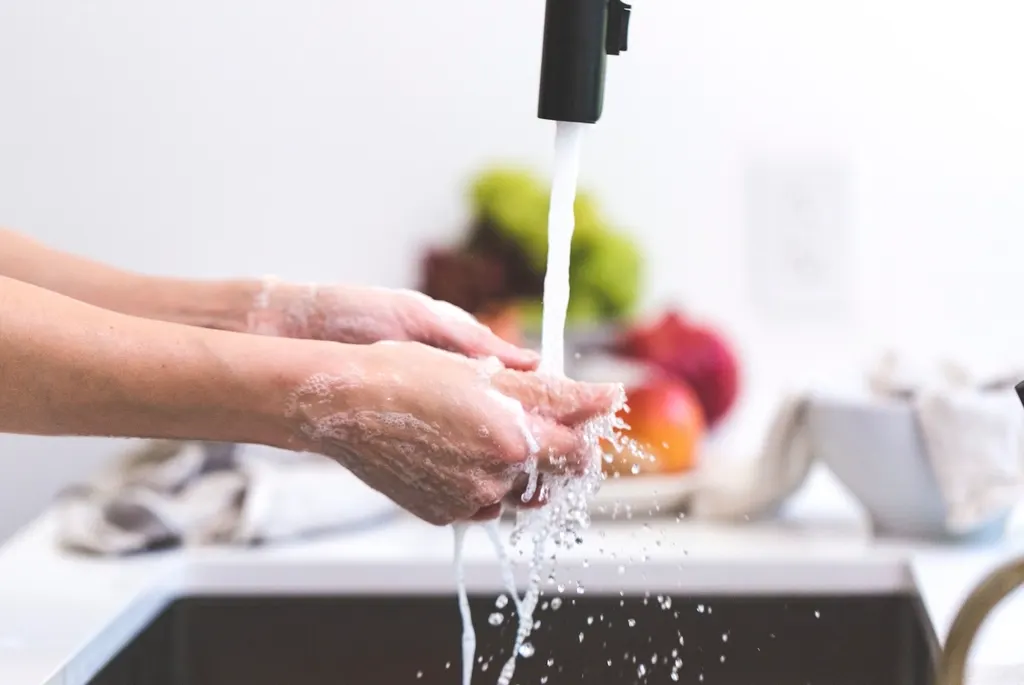
- Wash it first with hot soapy water and rinse. Sanitizing doesn't work well on a dirty surface.
- Apply a sanitizer. The USDA describes a solution of 1 tablespoon of unscented liquid chlorine bleach per gallon of water. Flood the surface and let it stand for several minutes.
- Rinse with clean water.
- Air-dry upright or pat dry with a clean towel.
After cutting raw chicken, you want to know your board is really clean, not just wiped. But there's a lot of conflicting advice out there: bleach or vinegar, lemon or hydrogen peroxide, dishwasher or hand wash. And the right method depends on what your board is made of.
This guide explains the difference between cleaning and sanitizing, the step-by-step method for each board material, which home remedies work and which don't, and how to choose a board that makes the whole job easier.
What's the difference between cleaning and sanitizing?
Cleaning removes food, grease and visible dirt with soap, water and scrubbing. Sanitizing reduces the number of germs on a surface that's already clean. You always clean first: soap and scrubbing remove most of the residue, and sanitizers work much better on a clean surface. For everyday vegetable prep, a good wash is usually enough. Sanitizing is an extra step many cooks use after raw meat, poultry and fish.
When should you sanitize a cutting board?
- After cutting raw meat, poultry, fish or seafood.
- Before using the same board for ready-to-eat foods.
- Once a week as a routine for busy kitchens.
- When someone in the household has been sick.
- If a board has been left dirty for a long time.
How do you sanitize a cutting board with bleach?
The USDA Food Safety and Inspection Service describes this method:
- Wash the board with hot soapy water and rinse.
- Mix 1 tablespoon of unscented liquid chlorine bleach in 1 gallon of water.
- Flood the surface of the board with the solution.
- Let it stand for several minutes.
- Rinse with clean water.
- Air-dry or pat dry with clean paper towels.
Use unscented bleach, mix a fresh solution each time, and work in a ventilated space. Never mix bleach with vinegar, ammonia or other cleaners, which can create harmful gases.
How do you sanitize each type of board?
| Board | Dishwasher | Bleach solution | Special notes |
|---|---|---|---|
| Titanium | Yes (check brand) | Yes, then rinse | Non-porous; easiest to get truly clean |
| Plastic | Usually | Yes | Deep grooves are hard to reach; replace worn boards |
| Glass | Yes | Yes | Avoid sudden temperature changes |
| Wood | No | Briefly, then rinse and dry | Never soak; re-oil after sanitizing |
| Bamboo | No | Briefly, then rinse and dry | Never soak; watch the glue lines |
How do you sanitize a titanium cutting board?
Titanium is the simplest. Because the surface is non-porous and resists deep scratches, there's very little for residue to hide in. After raw meat, either run it through the dishwasher or wash it with hot soapy water, then use the bleach solution if you want an extra step, rinse and dry. See how to clean a titanium cutting board.
How do you sanitize a plastic cutting board?
Plastic boards can go in the dishwasher or be sanitized with the bleach solution. The challenge is wear: as plastic boards develop knife grooves, residue can collect in them, and sanitizing can't fully reach deep scratches. That's why the USDA recommends replacing boards once they have hard-to-clean grooves. See when to replace a cutting board.
Plastic boards also shed microplastics with every cut, and worn boards keep shedding. A 2023 study estimated grams of particles per person per year from plastic boards (Yadav et al., 2023). See plastic cutting boards and microplastics.
How do you sanitize a wooden cutting board?
- Scrape and wash with hot soapy water; don't soak.
- Apply the diluted bleach solution or a 3% hydrogen peroxide spray briefly.
- Rinse quickly and dry with a towel right away.
- Stand it upright to finish drying.
- Once it's fully dry, re-oil with food-grade mineral oil, since sanitizers can dry out wood.
Never put wooden boards in the dishwasher; heat and water make them warp and crack. See how to care for a wood cutting board.
How do you sanitize a bamboo board?
Treat bamboo like wood: wash quickly, sanitize briefly, rinse, dry immediately and oil regularly. Bamboo boards are made of strips glued together, so soaking and dishwashers can make them split. See bamboo cutting board pros and cons.
Does vinegar sanitize a cutting board?
White vinegar is great for removing odors and mineral spots, and it has some antimicrobial activity. But household vinegar isn't a registered sanitizer and isn't as reliable as a properly diluted bleach solution. Use vinegar for deodorizing and freshening, not as your main sanitizing step after raw meat. And never use vinegar and bleach together.
What about hydrogen peroxide?
Drugstore 3% hydrogen peroxide is a common alternative for people who prefer not to use bleach. After washing, spray or pour it on the board, let it sit for a few minutes, then rinse and dry. It's gentle and doesn't leave a smell. Some people use it in sequence with vinegar, rinsing in between; never mix the two in the same container.
Do lemon and salt clean a cutting board?
A lemon and coarse salt scrub is a classic for wooden boards. It helps remove stains and odors from garlic, onion and fish, and the salt adds gentle abrasion. It's a nice freshening routine, but it isn't a substitute for washing with soap and water or for sanitizing after raw meat.
Is the dishwasher enough?
For dishwasher-safe boards like titanium, glass and many plastics, a normal dishwasher cycle with detergent and hot water does a thorough job of cleaning. Place boards upright so water reaches both sides. For wood and bamboo, the dishwasher isn't an option.
What other habits keep boards safe?
- Use separate boards for raw proteins and ready-to-eat foods.
- Clean right after use instead of leaving raw juices to sit.
- Wash your knife and hands too.
- Dry boards completely before storing them.
- Store boards upright with air around them.
- Replace worn boards with deep grooves, cracks or mold.
- Wash dishcloths and sponges often, or they can spread germs back onto the board.
See the best cutting board for raw meat.
Why do sponges and towels matter?
A clean board wiped with a dirty sponge isn't clean anymore. Kitchen sponges stay damp and collect food residue, which makes them a common source of germs. Replace sponges often, let them dry between uses, and use a fresh towel or paper towel to dry a board after sanitizing. Many people keep one dishcloth just for counters and another for dishes.
Which board makes sanitizing easiest?
The less porous and the less scratched a surface is, the easier it is to get clean. That's why non-porous boards are recommended for raw meat. Titanium combines that non-porous surface with scratch resistance and dishwasher safety, and it doesn't shed microplastics like plastic boards do. See titanium cutting board pros and cons.
The titanium board we recommend is Vanotium: non-porous, odor- and stain-resistant, dishwasher-safe, waterproof and fast-drying, heat-resistant and lightweight. On the official checkout in October 2026, one board was $66.66, with multi-packs from $42.77 per board and a 30-day guarantee. Read our Vanotium review (4.6/5).

The board that's easiest to get truly clean
Vanotium titanium cutting board: non-porous, dishwasher-safe, odor-resistant and microplastic-free. From $42.77 per board in multi-packs, with a 30-day guarantee.
Check today's Vanotium price →Ships in 5–7 days with tracking · 30-day guarantee
Can you keep a sanitizing spray ready to use?
Many people like having a spray bottle ready next to the sink. If you use bleach, the USDA-style solution is best mixed fresh, because diluted bleach loses strength over time and in sunlight. A practical approach is to mix a small batch in a labeled spray bottle, keep it out of reach of children and away from heat and light, and replace it often. Hydrogen peroxide should be kept in its original dark bottle, since light breaks it down; you can screw a spray nozzle onto many drugstore bottles. Always label any bottle you fill, and never refill a bottle that once held a different cleaner.
Should you sanitize the counter too?
Yes. When raw meat juices run off a board, they land on the counter, the sink edge and sometimes the faucet handle. After cutting raw proteins, wash and sanitize the counter area around the board, the knife handle and anything you touched, like the fridge door or spice jars. Using a large enough board and a damp towel underneath helps keep juices contained in the first place. Washing your hands with soap for at least 20 seconds is one of the most important steps of all.
Should you sanitize a brand-new board?
A new board should be washed with hot soapy water and rinsed before first use, to remove dust and any residue from manufacturing and packaging. Wooden and bamboo boards also benefit from an initial oiling. A full sanitizing step isn't usually necessary on a new board, but it doesn't hurt if it gives you peace of mind.
What's a simple cleaning and sanitizing schedule?
- After every use: wash with hot soapy water, rinse and dry.
- After raw meat, poultry or fish: wash right away, then dishwasher or sanitizer.
- Weekly: sanitize all boards; oil wood and bamboo.
- Monthly: inspect boards for grooves, cracks and mold; replace if needed.
What are the most common sanitizing mistakes?
- Sanitizing without washing first.
- Using too much bleach; stronger isn't better and leaves residue and odor.
- Mixing bleach with vinegar or ammonia.
- Soaking wooden or bamboo boards.
- Skipping the final rinse after bleach.
- Keeping deeply grooved plastic boards in use.
The bottom line
To sanitize a cutting board, wash it first, then use a diluted bleach solution (1 tablespoon of unscented liquid chlorine bleach per gallon of water) or the dishwasher for dishwasher-safe boards, rinse and dry. Wood and bamboo need a quick, gentle routine and regular oiling. Non-porous boards, especially titanium, make the whole job easier and more reliable.
Our pick is Vanotium. Check today's Vanotium price on the official site.
Sources
- USDA Food Safety and Inspection Service. Cutting Boards and Food Safety.
- Yadav H. et al. Cutting Boards: An Overlooked Source of Microplastics in Human Food? Environmental Science & Technology, 2023.
Frequently asked questions
What is the best way to sanitize a cutting board?
Wash it first, then use a solution of 1 tablespoon of unscented liquid chlorine bleach per gallon of water, let it stand several minutes, rinse and dry.
Does vinegar sanitize a cutting board?
Vinegar removes odors and has some antimicrobial activity, but it isn't as reliable as diluted bleach. Never mix it with bleach.
Can you put a cutting board in the dishwasher?
Titanium, glass and many plastic boards, yes. Wood and bamboo, no; they warp and crack.
How do you sanitize a wooden cutting board?
Wash quickly, apply diluted bleach or 3% hydrogen peroxide briefly, rinse, dry right away and re-oil once dry.
How often should you sanitize a cutting board?
After raw meat, poultry or fish, and about once a week as a routine.
Can you sanitize a scratched plastic board?
Deep grooves are hard to reach with any sanitizer, so the USDA recommends replacing heavily worn boards.

Michelle Hert
Michelle is a home cook who cooks for a family every day and spends a lot of her free time reading the research behind the products that end up in our kitchens. She started Less Plastic Kitchen after the 2023 cutting board study made her look twice at the scratched plastic board on her own counter. Her guides are built on published studies, manufacturer specifications and verified buyer feedback, and she updates them when new information comes out. More about Michelle.