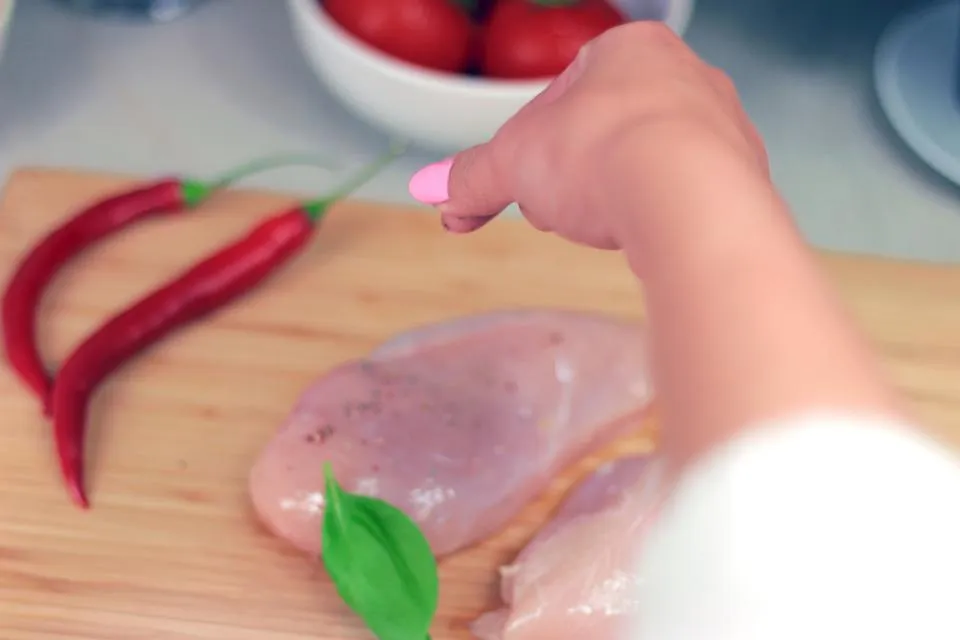
- Pinch the blade just in front of the handle between your thumb and the side of your bent index finger.
- Wrap your other three fingers around the handle.
- Keep your wrist straight and let the knife move from the elbow and shoulder.
Most home cooks hold a chef knife like a hammer: the whole hand wrapped around the handle, index finger pointing along the spine. It feels natural, but it gives you less control, tires your wrist and makes the blade wobble on dense foods. Professional cooks are taught a different grip on day one, and it changes everything: faster, more even cuts, less effort and fewer slips. This guide explains how to hold a chef knife properly, how to position your guiding hand, the basic cutting motions, the mistakes to avoid and how to practice so the new grip becomes second nature.
In this guide:
- the pinch grip, step by step
- the claw grip for your guiding hand
- other grips and when to use them
- the four basic cutting motions
- how to stand and set up your board
- common mistakes and how to fix them
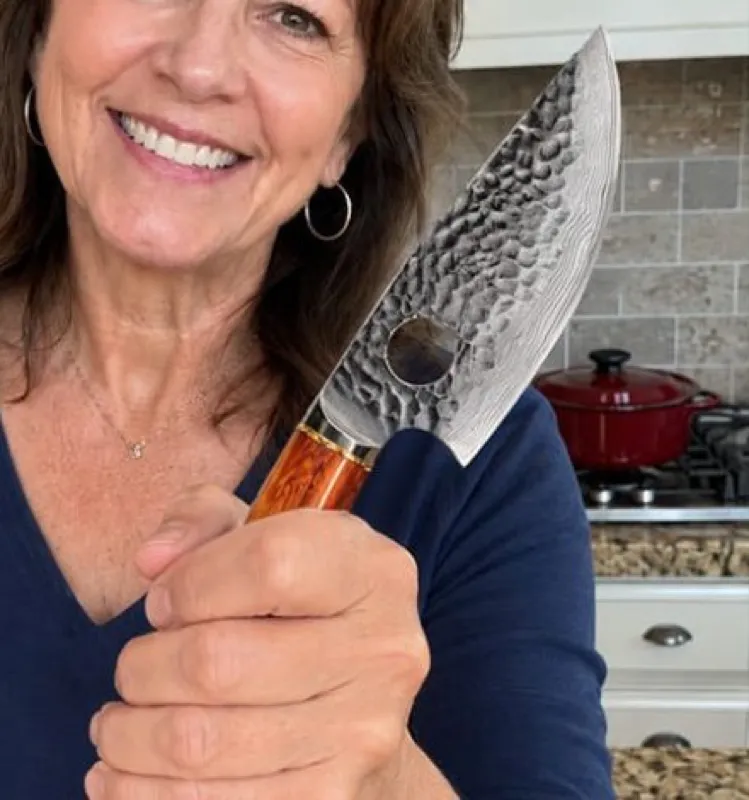
Pair it with: the Matsato Osuren chef knife
Hammered Japanese-style steel blade with a 12° edge, a finger hole for control and a pakka and acacia wood handle. $29.95 for one, or $19.98 each in the 4-pack.
Check today's Matsato price →60-day money-back guarantee · free recipe book with your order
Why does the way you hold a knife matter?
Grip controls three things: where the edge goes, how much force reaches the food and how tired your hand gets. With a loose "hammer" grip, the blade can twist sideways in a carrot or a squash, and that's exactly when slips happen. With a pinch grip, your thumb and finger hold the blade itself, so it stays upright and goes where you aim it. Cuts come out more even, which means food cooks more evenly too.
A good grip also works hand in hand with a sharp knife. A dull blade needs force, and force is what makes knives skid off a tomato skin or an onion. Sharp knife plus correct grip is the safest combination in the kitchen.
How do you do the pinch grip?
- Hold the handle loosely in your dominant hand.
- Slide your hand forward until your thumb and index finger reach the blade, just in front of the handle (the "bolster" or heel area).
- Pinch the blade: thumb flat on one side, the side of your curled index finger on the other.
- Wrap the remaining three fingers around the handle. They hold it gently; they don't squeeze.
- Check your wrist: it should be straight, in line with your forearm.
At first it can feel strange to have your fingers on the blade. That's normal. Your fingers are on the flat side, well behind the edge, and after a few days it will feel more natural than the old grip.
How does the Matsato Osuren finger hole help?
The Matsato Osuren has a round hole near the heel of the blade. Your index finger goes through it, and your thumb rests on the side of the blade. It's essentially a built-in pinch grip: the hole tells your finger exactly where to sit and keeps the blade from twisting, even in dense foods like sweet potatoes and squash.
- For beginners, it's a shortcut to the right grip.
- For hard vegetables, it adds stability when you push down.
- For long prep sessions, many cooks find it less tiring.
Prefer a traditional grip? You can ignore the hole and hold the knife like any other chef knife. Most buyers say it takes just a few minutes to get used to. See our Matsato Osuren review.
A chef knife with the pinch grip built in
The Matsato Osuren's finger hole gives a stable pinch grip from day one, with a 12° edge and a pakka and acacia handle. $29.95, or $19.98 per knife in the 4-pack, with a 60-day money-back guarantee.
Check today's Matsato price →60-day money-back guarantee · free recipe book with your order
What is the claw grip for the other hand?
Your non-knife hand matters just as much. It holds the food and guides the blade, and the claw keeps your fingertips out of the way:
- Curl your fingertips under, as if you were gently holding a ball.
- Rest your fingertips on top of the food, tucked behind your knuckles.
- Let the flat of the blade touch your middle knuckle lightly. It acts as a guide.
- Tuck your thumb behind your fingers, never sticking out in front.
- Walk your hand back slowly after each cut, and the blade follows.
Because your knuckles stand in front of your fingertips, the blade meets a flat knuckle, not a nail or a fingertip. The thickness of each slice is set by how far you move your claw back.
Are there other knife grips?
| Grip | How | When to use it |
|---|---|---|
| Pinch grip | Thumb and index finger on the blade | Most chopping, slicing and dicing |
| Handle grip | Whole hand on the handle | Light tasks; some people with small hands |
| Point grip | Index finger along the spine | Delicate tip work; not for chopping |
| Palm press | Flat palm on the spine (other hand) | Pushing through very hard food, carefully |
The point grip (index finger on the spine) is the one most people use by habit. It's fine for scoring or fine tip cuts, but for everyday chopping it gives less control from side to side.
How should you stand at the cutting board?
- Stand square to the counter, about a fist's distance away, feet shoulder-width apart.
- Angle your body slightly so your knife arm has room to move freely.
- Board height: ideally your elbow bends at about 90 degrees with the knife on the board. If the counter is too high, stand on a sturdy step; if it's low, a thicker board helps.
- Stop the board sliding: put a damp towel or a non-slip mat underneath. See how to stop a cutting board slipping.
- Keep the board clear: push finished food to one side or into a bowl.
What are the basic cutting motions?
Once your grip is right, four motions cover almost everything:
- Rock chop: the tip stays on the board while the heel rises and falls. Great for herbs, garlic and finely chopping onions.
- Push cut: push the knife forward and down through the food, tip first. Ideal for carrots, celery and cucumbers.
- Pull cut (slice): draw the knife back toward you through the food. Good for soft items like tomatoes, raw fish and boneless meat.
- Up-and-down chop: lift and lower the whole blade. Useful for scallions and quick rough chopping.
In every motion, let the edge do the work. If you're forcing it, the knife probably needs honing or sharpening. See how to sharpen a chef knife.
How do you hold the knife to dice an onion?
- Cut the onion in half through the root, peel it and lay it flat-side down.
- Hold it with a claw grip, root end away from the knife.
- With a pinch grip, make vertical cuts from the tip end toward the root, stopping short of the root so the onion holds together.
- If you like, make one or two careful horizontal cuts toward the root, keeping your guiding hand flat on top.
- Slice across the cuts, walking your claw back, and the onion falls into dice.
A sharp, thin edge makes a real difference here: clean cuts release less of the juice that makes your eyes water.
How do you hold the knife for hard vegetables?
Squash, sweet potatoes and celeriac are where grip matters most. Some tips:
- Make a flat base first: trim a thin slice off one side so the vegetable doesn't roll.
- Use the pinch grip (or the Matsato finger hole) for stability.
- Cut with the heel of the blade, where it's strongest.
- For extra force, rest your guiding palm flat on the spine, fingers well clear of the edge, and press down steadily.
- Never twist the blade to crack food open. Finish the cut instead.
More control on squash, onions and herbs
Hammered Damascus-pattern blade, 12° edge and a finger hole for a secure grip. The 4-pack brings the Matsato Osuren to $19.98 per knife.
Check today's Matsato price →60-day money-back guarantee · free recipe book with your order
What are the most common knife grip mistakes?
- Index finger on the spine for chopping: less side-to-side control.
- Squeezing too hard: a death grip tires your hand and makes cuts jerky.
- Bent wrist: keep it straight and move from the elbow.
- Flat fingers on the food: always curl them into a claw.
- Thumb sticking out in front of the guiding hand.
- Looking away while cutting. Pause, then talk.
- Using a dull knife: more force means more slips.
How do you practice the right grip?
Change takes about a week of everyday cooking:
- Start slow. Speed comes on its own once the motion is right.
- Practice on easy foods like cucumbers, zucchini and celery.
- Focus on one thing at a time: day one the pinch grip, day two the claw.
- Check yourself every few cuts: wrist straight, fingertips tucked.
- Cook every day with the same knife, so your hand learns its balance.
Many cooks find that organizing everything before they start, the classic mise en place, makes them calmer and safer at the board.
What are the basic knife safety rules?
- Keep knives sharp; a sharp knife needs less force.
- Never try to catch a falling knife. Step back and let it drop.
- Carry a knife point down, blade facing back, close to your side.
- Never leave a knife in a sink full of water.
- Wipe the blade from spine to edge, away from your fingers.
- Store knives in a block, on a magnetic strip or in a guard, not loose in a drawer.
For more on keeping your knife in top shape, see how to care for the Matsato Osuren.
What kind of chef knife is easiest to hold?
Look for a balanced knife that doesn't feel blade-heavy or handle-heavy, a comfortable handle that doesn't slip when wet, and a blade around 7 to 8 inches for most home cooks. A Japanese-style blade is usually a little lighter and thinner than a heavy German knife, which many people find easier to control. See Japanese vs German chef knives.
| Feature | Why it helps your grip |
|---|---|
| Finger hole or bolster | Shows your index finger where to rest |
| Wooden handle | Warm, grippy, comfortable for long sessions |
| Thin, sharp edge | Less force needed, so fewer slips |
| Hammered blade | Food releases more easily, so less fiddling |
Does the cutting board affect control?
Yes. A board that slides or rocks undermines even the best grip. Choose a board big enough to hold the food and a pile of cut pieces, stable on the counter and kind to the edge: wood, quality plastic or titanium, never glass or stone. See our cutting board size guide and the best cutting board for vegetables.
How do you teach older kids to hold a knife?
Start with soft foods like bananas or cucumbers and a smaller, sharp knife, under close supervision. Teach the claw first, then the pinch grip. Keep sessions short and praise slow, careful cutting rather than speed.
Is the grip different for left-handed cooks?
No, it's simply mirrored: the pinch grip in the left hand and the claw in the right. The Matsato Osuren's finger hole works for either hand, since it sits in the center of the blade near the heel.
Which parts of a chef knife should you know?
Knowing the parts makes grip instructions easier to follow. A chef’s knife has a tip for fine work, a curved belly for rocking, the edge that does the cutting, a flat spine on top, the heel at the back of the edge for heavy cuts, and the bolster or finger area where your pinch grip sits, just in front of the handle. On the Matsato Osuren, the finger hole sits right at that heel area, which is why it lines your index finger up with the pinch grip.
The bottom line
To hold a chef knife properly:
- use the pinch grip: thumb and index finger on the blade, three fingers around the handle
- keep your wrist straight and move from the elbow
- guide the food with a claw: fingertips tucked, knuckles forward
- let a sharp edge do the work and practice slowly for a week
A knife with a built-in grip makes it easier. The Matsato Osuren's finger hole sets your index finger in the right spot, with a 12° edge and a pakka and acacia handle. It's $29.95, or $19.98 per knife in the 4-pack, with a 60-day money-back guarantee.
Pair it with: the Matsato Osuren chef knife
Hammered Japanese-style steel blade with a 12° edge, a finger hole for control and a pakka and acacia wood handle. $29.95 for one, or $19.98 each in the 4-pack.
Check today's Matsato price →60-day money-back guarantee · free recipe book with your order
Frequently asked questions
What is the correct way to hold a chef knife?
The pinch grip: thumb and the side of your index finger pinch the blade just in front of the handle, with the other three fingers around the handle.
Why shouldn't I put my finger on the spine?
It gives less side-to-side control for chopping. It's fine only for delicate tip work.
What is the claw grip?
Your guiding hand holds the food with fingertips curled under and knuckles forward, so the blade meets a flat knuckle, not a fingertip.
Does a finger hole on a knife help?
Yes. The Matsato Osuren's finger hole sets your index finger in a pinch-grip position and keeps the blade steady.
How long does it take to learn the pinch grip?
Usually about a week of everyday cooking. Start slowly on easy foods like cucumbers.
Is the grip different for left-handed people?
No, it's mirrored: pinch grip in the left hand and claw grip in the right.

Michelle Hert
Michelle is a home cook who cooks for a family every day and spends a lot of her free time reading the research behind the products that end up in our kitchens. She started Less Plastic Kitchen after the 2023 cutting board study made her look twice at the scratched plastic board on her own counter. Her guides are built on published studies, manufacturer specifications and verified buyer feedback, and she updates them when new information comes out. More about Michelle.