- Weight: titanium is about 40% lighter than steel for the same size, so a titanium board is easier to lift, carry and wash.
- Corrosion: titanium is highly resistant to corrosion, including salt and acidic foods; stainless steel resists rust well but can spot or pit over time in harsh conditions.
- Hidden plastic: many "stainless" boards are double-sided with a plastic side; check what you're buying.
- Price: stainless boards are often cheaper.
Metal cutting boards have become popular as people move away from plastic. Two materials dominate: stainless steel and titanium. They look similar in photos, and both promise hygiene and durability, so it's natural to wonder whether titanium is worth paying a little more for.
This guide compares stainless steel and titanium cutting boards on weight, hygiene, durability, corrosion, knife feel, cleaning and price, and explains who should choose which.
Why are people switching to metal cutting boards?
The main reason is plastic. A 2023 study in Environmental Science & Technology estimated that plastic boards release microplastics with every cut, adding up to 7.4 to 50.7 grams per person per year from polyethylene boards (Yadav et al., 2023). Metal boards avoid that entirely. They're also non-porous, which the USDA notes makes a surface easier to clean than wood. See plastic cutting boards and microplastics.
How do stainless steel and titanium boards compare?
| Titanium | Stainless steel | |
|---|---|---|
| Weight | About 40% lighter for the same size | Heavier |
| Corrosion resistance | Excellent, including salt and acids | Very good; can spot or pit in harsh conditions |
| Non-porous | Yes | Yes |
| Plastic-free | Yes (single-material boards) | Yes, unless double-sided with plastic |
| Dishwasher-safe | Yes (check brand) | Yes (check brand) |
| Odor and stain resistance | Excellent | Excellent |
| Heat resistance | Excellent; doubles as a trivet | Excellent |
| Nickel content | None | Common grades contain nickel |
| Price | Medium | Often lower |
Why does weight matter so much?
Titanium's density is roughly 4.5 grams per cubic centimeter, compared with about 8 for stainless steel. For a cutting board, that means a titanium board of the same size and thickness weighs a little over half as much. In daily use, that's the difference you'll notice most: lifting the board to slide chopped onions into a pan, carrying it to the sink, holding it under the tap or loading it into the dishwasher. For people with arthritis or weaker wrists, and for anyone who cooks every day, a lighter board is simply more pleasant.
Which resists corrosion better?
Titanium is famous for corrosion resistance, which is why it's used in marine hardware, medical implants and aerospace parts. It forms a stable oxide layer that protects it from salt, acidic foods like lemon and tomato, and repeated washing. Stainless steel also resists rust very well, especially food-grade 304 steel, but it can develop spots, tea staining or pitting over long periods, particularly with salty or acidic foods left sitting or in harsh dishwasher conditions. For a board that sees lemon juice, brine and marinades daily, titanium has the edge.
Does nickel in stainless steel matter?
Common food-grade stainless steels like 304 contain nickel. For most people, that's not a concern. But some people with nickel sensitivity prefer to minimize nickel contact. Titanium contains no nickel, which is one reason it's widely used in medical implants and jewelry for sensitive skin. See are titanium cutting boards safe?
Do some "stainless steel" boards contain plastic?
Yes, and it's worth checking. Many popular stainless steel boards are double-sided: one side metal, the other side wheat-straw plastic, polypropylene or another composite. The idea is to use the plastic side for vegetables and the metal side for meat. If your goal is to remove plastic from food prep, that defeats the purpose. Check the product description carefully for words like "PP," "wheat straw," "composite" or "dual-sided." A single-material titanium board avoids this.
How do they compare for knives?
Both are metal surfaces, and how either one treats your knives depends on the specific board, its finish and how you cut. Titanium is softer than the hardened steel in kitchen knives, which is why titanium boards are described as knife-friendly with proper care. Whichever metal board you choose, the habits are the same: slice with a smooth pulling or rocking motion, use the spine to scrape food, and hone your knife every week or two. See do titanium cutting boards dull knives?
Which is more hygienic?
Both are non-porous and easy to clean, and both can go in the dishwasher (check each brand). Neither absorbs juices or odors the way wood and scratched plastic can. In practice, hygiene is a tie; what matters more is cleaning the board right after raw meat and using separate boards for raw proteins and ready-to-eat foods. See how to sanitize a cutting board and the best cutting board for raw meat.
Which lasts longer?
Both are far more durable than plastic and won't crack or warp from moisture like wood. Titanium's corrosion resistance and strength-to-weight ratio make it especially long-lasting, and its brushed finish hides everyday use marks well. A good board in either metal should last many years; a titanium board avoids the long-term spotting or pitting that stainless can show in harsh conditions. See when to replace a cutting board.
Are metal boards noisy?
Any hard board makes more sound than wood. Placing a damp towel or a thin non-slip mat under the board reduces noise and stops it sliding. Slicing rather than chopping straight down also keeps things quieter and is better for your knife edge. Lighter boards like titanium are also easier to lift and reposition on the mat.
Is titanium worth the extra cost?
Stainless steel boards are often cheaper, especially double-sided models. Titanium costs more upfront, but you get a lighter board, top-tier corrosion resistance, no nickel and a fully plastic-free surface. Spread over years of daily use, the difference is small. Multi-packs also bring the price down: Vanotium's four-pack works out to $42.77 per board.
Which titanium board do we recommend?
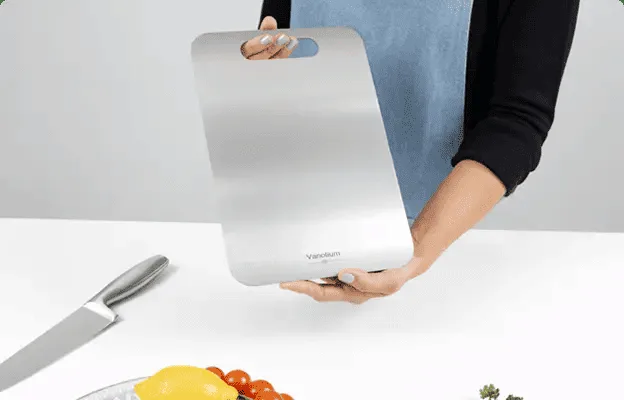
Our pick is Vanotium. Its advanced titanium surface is non-porous, odor- and stain-resistant, dishwasher-safe, waterproof and fast-drying, scratch-resistant and warp-proof, heat-resistant and lightweight, with a built-in handle cut-out. On the official checkout in October 2026, one board was $66.66, two were $116.66, three were $143.31 and four were $171.08, with a 30-day guarantee and tracked shipping in about 5 to 7 days. Read our Vanotium review (4.6/5) and our titanium cutting board comparison.

Lighter than steel, fully plastic-free
Vanotium titanium cutting board: lightweight, corrosion-resistant, non-porous and dishwasher-safe, with no plastic side. From $42.77 per board in multi-packs, with a 30-day guarantee.
Check today's Vanotium price →Ships in 5–7 days with tracking · 30-day guarantee
Who should choose titanium?
- People who cook daily and lift and wash their board often.
- Anyone with arthritis or wrist pain who wants a lighter board.
- Cooks who work with salty, acidic and marinated foods.
- People with nickel sensitivity.
- Anyone who wants a single-material, fully plastic-free board.
Who might choose stainless steel?
- Buyers on a tighter budget who don't mind extra weight.
- Cooks who mainly use a board for occasional tasks or as a prep tray.
- People who already have stainless prep surfaces and like a matching look (choose a single-material board).
How do you care for a metal cutting board?
- Wash with hot soapy water and a soft sponge, or use the dishwasher.
- Clean right after raw meat, poultry or fish.
- Towel-dry to prevent water spots, especially with hard water.
- Use a baking soda paste for stubborn residue and a vinegar wipe for mineral spots.
- Avoid steel wool and harsh abrasive powders.
See how to clean a titanium cutting board.
How do metal boards compare with wood, bamboo and glass?
Wood is the gentlest surface for knives and looks beautiful, but it's porous, needs oiling and can't go in the dishwasher. Bamboo is cheap and light but harder on knives and can split along its glue lines. Glass is non-porous and dishwasher-safe but very hard on knives and slippery. Metal boards, and especially titanium, combine the non-porous hygiene of glass with easy dishwasher care and long life, without plastic. See wood vs plastic, bamboo pros and cons and glass pros and cons.
What should you check before buying any metal board?
- Single material: confirm both sides are metal, with no plastic, wheat-straw or composite side.
- Material grade: for stainless, look for food-grade 304 or similar; for titanium, look for clear information about the titanium surface.
- Size and thickness: big enough for your usual jobs, but light enough to lift with one hand.
- Edges and handle: smooth, rounded edges and a handle cut-out make it safer and easier to carry.
- Dishwasher guidance: check the maker's instructions.
- Return policy or guarantee: so you can try it at home. Vanotium offers a 30-day guarantee.
What's it like to use each one every day?
In everyday cooking, the first thing most people notice with a stainless steel board is its heft: it feels solid on the counter but takes effort to lift over a pan or into the sink. A titanium board feels similar under the knife but is noticeably easier to pick up, tilt and rinse. Both clean up quickly and don't keep the smell of last night's garlic. Over months, stainless may start showing faint spots from salty or acidic foods, while titanium's brushed finish tends to stay consistent. For a board you'll handle several times a day, those small differences add up.
What are common myths about metal cutting boards?
- "All metal boards are the same." Weight, corrosion resistance and construction differ.
- "Stainless steel boards are always plastic-free." Many are double-sided with plastic.
- "Metal boards are only for professionals." They're increasingly popular in home kitchens because they're easy to clean.
- "Titanium is too expensive." Multi-packs bring the per-board price close to good wooden boards.
The bottom line
Stainless steel and titanium cutting boards are both non-porous, plastic-free (if single-material), dishwasher-safe and durable. Titanium wins on weight, corrosion resistance and nickel-free construction, while stainless steel is often cheaper. For a light, long-lasting, fully plastic-free everyday board, titanium is our choice.
Our pick is Vanotium. Check today's Vanotium price on the official site.
Sources
- Yadav H. et al. Cutting Boards: An Overlooked Source of Microplastics in Human Food? Environmental Science & Technology, 2023.
- USDA Food Safety and Inspection Service. Cutting Boards and Food Safety.
Frequently asked questions
Is titanium or stainless steel better for a cutting board?
Both are non-porous and dishwasher-safe. Titanium is about 40% lighter, more corrosion-resistant and nickel-free; stainless is often cheaper.
Are stainless steel cutting boards plastic-free?
Single-material ones are, but many popular stainless boards are double-sided with a plastic or wheat-straw side.
Is a titanium cutting board lighter than stainless steel?
Yes. Titanium's density is about 4.5 g/cm³ versus about 8 for steel, so a same-size board weighs a little over half as much.
Do stainless steel boards contain nickel?
Common food-grade grades like 304 contain nickel; titanium contains none.
Which metal board is more hygienic?
Both are non-porous and easy to clean; hygiene is a tie. Clean right after raw meat and use separate boards.
Is a titanium cutting board worth the price?
For a light, corrosion-resistant, fully plastic-free daily board, yes; multi-packs bring Vanotium to $42.77 per board.

Michelle Hert
Michelle is a home cook who cooks for a family every day and spends a lot of her free time reading the research behind the products that end up in our kitchens. She started Less Plastic Kitchen after the 2023 cutting board study made her look twice at the scratched plastic board on her own counter. Her guides are built on published studies, manufacturer specifications and verified buyer feedback, and she updates them when new information comes out. More about Michelle.