
- Best for: home cooks who want one sharp, good-looking knife for vegetables, herbs, meat and fish.
- What buyers like: the out-of-the-box sharpness, the grip from the finger hole and the price compared with store-bought Japanese knives.
- Small trade-offs: hand-wash only, and the finger hole takes a few minutes to get used to.
A dull, wobbly chef knife makes every dinner slower and less safe. That's why the Matsato Osuren has been getting so much attention: it promises a razor-sharp Japanese-style edge, a distinctive hammered blade and a comfortable wooden handle at a fraction of what many boutique knives cost. In this review we look at what the Matsato Osuren actually is, how it's built, what it does well, the few things to know before you order, the real prices and bundles, and how it fits into a kitchen that's trying to use less plastic.
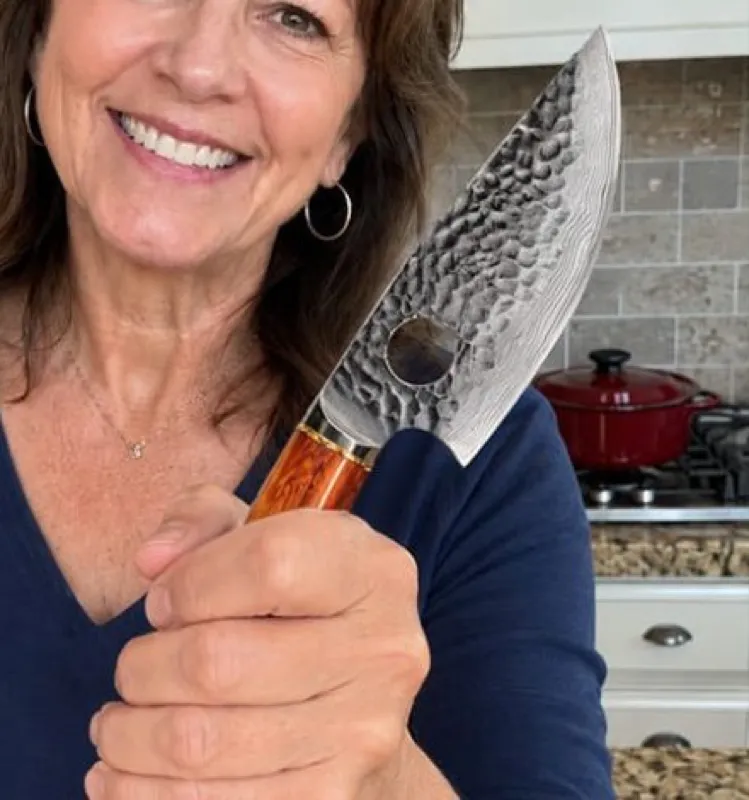
Pair it with: the Matsato Osuren chef knife
Hammered Japanese-style steel blade with a 12° edge, a finger hole for control and a pakka and acacia wood handle. $29.95 for one, or $19.98 each in the 4-pack.
Check today's Matsato price →60-day money-back guarantee · free recipe book with your order
What is the Matsato Osuren knife?
The Matsato Osuren is an all-purpose chef knife inspired by traditional Japanese knife-making. It sits somewhere between a classic chef knife and a santoku: the blade is wide enough to scoop up chopped vegetables, curved enough to rock through herbs and pointed enough for detail work like trimming meat or scoring bread.
Three details set it apart from a regular supermarket knife:
- The hammered blade. The surface has a hand-hammered look with a wavy Damascus-style pattern. Beyond looking great, a dimpled surface helps slices of potato, cucumber and onion release from the blade instead of sticking.
- The finger hole. A round hole near the heel of the blade lets you rest your index finger inside it. It gives you a pinch-style grip with extra stability when you're cutting dense foods like squash or sweet potatoes.
- The 12° edge. Matsato grinds the edge to about 12 degrees per side. Most Western kitchen knives use roughly 15 to 20 degrees, so a 12° edge feels noticeably keener and glides through tomatoes and herbs with less pressure.
The handle is made of pakka wood and acacia, a dense, water-resistant combination that feels warm in the hand and gives the knife a balanced weight. It's a real alternative to the plastic handles found on most budget knives, which is one reason it suits readers of this site.
What are the key specs and features?
| Feature | Matsato Osuren |
|---|---|
| Knife style | Japanese-style chef knife (chef/santoku hybrid) |
| Blade | Ice-hardened steel with a hammered, Damascus-pattern finish |
| Edge angle | About 12° per side |
| Grip | Finger hole near the heel for a stable pinch grip |
| Handle | Pakka and acacia wood |
| Extras | Free recipe book with your order; optional gift box |
| Guarantee | 60-day money-back guarantee; the brand also advertises a lifetime warranty |
| Where to buy | Online only, on the official Matsato site |
The brand describes the steel as "ice-hardened". In knife-making, cryogenic or ice hardening is a step that follows heat treatment and helps steel hold an edge longer. The practical result for you is a knife that should need sharpening less often than a soft, inexpensive blade.
How much does the Matsato Osuren cost?
The Matsato Osuren is only sold through its official website, and the price per knife drops as you buy more. These were the prices on the official order page when we checked:
| Package | Total | Per knife |
|---|---|---|
| 1 knife | $29.95 | $29.95 |
| 2 knives | $49.94 | $24.97 |
| 3 knives | $65.94 | $21.98 |
| 4 knives | $79.92 | $19.98 |
The site lists the regular price at around $99 per knife and regularly runs discounts of up to 70%. The multi-packs make the most sense if you want one knife for yourself and a few for gifts: four knives at under $20 each is a strong deal for a hammered Japanese-style blade with a wooden handle. Prices change with promotions, so it's worth checking the current offer before you order.
Check the current Matsato bundle prices
The 4-pack brings the Matsato Osuren down to $19.98 per knife, and every order is covered by a 60-day money-back guarantee.
Check today's Matsato price →60-day money-back guarantee · free recipe book with your order
How sharp is it, and does it stay sharp?
Sharpness is the number one thing buyers mention. A 12° edge cuts with less force than the wider edges on most Western knives, so tomatoes don't squash, herbs don't bruise and onions slice cleanly instead of crushing. That's not just nicer to use; it's safer. A sharp knife goes where you aim it, while a dull one needs more pressure and is more likely to slip.
How long the edge lasts depends on two things you control: how you store the knife and what you cut on. Glass, stone and ceramic surfaces roll a fine edge in just a few cuts. Wood, quality plastic and titanium are far kinder. We explain the numbers in do titanium cutting boards dull knives: kitchen knife steel is harder than the titanium used for boards, so the board gives way to the blade, not the other way around.
A few light strokes on a honing rod every week or two keep the edge aligned, and a proper sharpening two or three times a year is plenty for most home cooks.
Is the finger hole actually useful?
Yes, once you get used to it. With your index finger through the hole and your thumb on the side of the blade, you get a secure pinch grip that keeps the knife from twisting in dense foods. Many cooks find it especially reassuring for:
- Splitting butternut squash, sweet potatoes and cabbage
- Breaking down a chicken or trimming a roast
- Fast, controlled slicing of onions and peppers
If you prefer a traditional handle grip, you can simply ignore the hole and hold the knife like any other chef knife. It doesn't get in the way.
What are the pros and cons?
Pros
- Very sharp 12° edge straight out of the box
- Hammered blade helps food release
- Finger hole adds control in tough foods
- Wooden pakka and acacia handle, no plastic grip
- Low price per knife in bundles
- 60-day money-back guarantee
- Makes an impressive gift
Cons
- Hand-wash only (true for any good knife)
- The finger hole takes a few minutes to get used to
- Sold online only, so you can't try it in a store first
None of the trade-offs are deal-breakers. Hand-washing is the right way to treat any sharp knife, and the guarantee covers you if the grip simply isn't for you.
Who should buy the Matsato Osuren?
The Matsato Osuren is a great fit if you:
- Cook most days and are tired of a dull knife that crushes tomatoes
- Want one versatile knife instead of a crowded block full of plastic handles
- Like the look of a hammered Japanese-style blade
- Are shopping for a holiday or housewarming gift for someone who loves to cook (see our gift guide for home cooks)
It's less suited to anyone who wants a knife they can throw in the dishwasher. No quality knife should go in the dishwasher, because the heat, detergent and rattling dull the edge and can damage wooden handles.
Which cutting board should you use with it?
A sharp knife deserves a surface that protects its edge and stays hygienic. Glass and stone boards are the worst choice: they're hard on edges and slippery. Our top pick for a low-plastic kitchen is a titanium board like Vanotium. It's non-porous, doesn't shed plastic particles, doesn't hold odors, and it's softer than knife steel, so a fine edge like the Matsato's isn't chipped or rolled.
If you'd rather go natural, a thick end-grain wood board is also gentle on knives, with a little more maintenance. Compare the options in how to choose a cutting board, or read our full Vanotium review.

The board we pair with a sharp knife
Vanotium's titanium surface is non-porous, knife-friendly and dishwasher-safe. Multi-board deals bring it down to $42.77 per board.
Check today's Vanotium price →Ships in 5–7 days with tracking · 30-day guarantee
How do you care for the Matsato Osuren?
- Wash by hand with warm water and a drop of dish soap right after use.
- Dry immediately with a towel, blade and handle, so no water sits on the steel.
- Store it safely on a magnetic strip, in a knife block or with a blade guard, never loose in a drawer.
- Hone regularly with a few light strokes on a honing rod.
- Oil the handle occasionally with a food-safe mineral oil to keep the wood looking rich.
- Use the right board: wood, quality plastic or titanium, never glass or stone.
Follow these steps and the knife should stay sharp and good-looking for years.
How does it compare with other chef knives?
| Matsato Osuren | Typical supermarket chef knife | Premium Japanese knife | |
|---|---|---|---|
| Edge angle | About 12° | 15–20° | 10–15° |
| Handle | Pakka and acacia wood | Often plastic | Wood or composite |
| Grip aid | Finger hole | None | Usually none |
| Price per knife | $19.98–$29.95 | $15–$40 | $100–$300+ |
| Guarantee | 60 days | Varies | Varies |
For most home cooks, the Matsato Osuren hits a sweet spot: a sharper edge and a nicer handle than a basic supermarket knife, at a fraction of the price of a premium handmade Japanese blade.
Is the Matsato Osuren legit?
Yes. The knife is sold through an official website with a listed US phone number and support email, standard secure checkout and a written 60-day money-back guarantee. Like many direct-to-consumer brands, it's only available online, and you'll see countdown timers and promotional pricing on the site. To shop safely, order through the official site rather than third-party marketplaces, keep your order confirmation, and contact support within 60 days if you want to return it.
Because many copycat "review" pages repeat the same marketing text, we focused on the specs the brand states and on how a knife like this performs on the boards we recommend.
What are the best tips for your first week with it?
A new, very sharp knife can feel different from the one you've been using for years. These habits help you get the most out of it from day one:
- Let the blade do the work. Use a smooth forward or rocking motion instead of pressing straight down. A 12° edge needs very little force.
- Curl your fingertips. Hold food with the "claw" grip, fingertips tucked in and knuckles guiding the side of the blade.
- Practice the finger-hole grip on easy foods first, like cucumbers or zucchini, before you tackle a hard squash.
- Scrape with the spine. Move chopped food across the board with the back of the knife, not the sharp edge, to keep the edge aligned.
- Don't use it as a can or package opener. Twisting and prying chip fine edges; keep a pair of kitchen scissors for that.
The USDA also recommends using separate boards for raw meat and for ready-to-eat foods like vegetables and bread. With one sharp knife and two easy-to-clean boards, prep stays both fast and safe. See the best cutting board for raw meat for ideas.
Does it help reduce plastic in the kitchen?
In a small way, yes. Many budget knives come with plastic handles that crack, discolor and eventually get thrown away, and a dull knife often tempts people to buy pre-cut produce in plastic packaging. One durable knife with a wooden handle that you keep for years is a simple, practical swap. Combine it with a non-plastic cutting board and natural tools like those in our guide to non-toxic kitchen utensils, and you remove some of the most-used plastic items from your daily cooking.
What does "ice-hardened steel" mean for you?
Steel hardness is usually measured on the Rockwell C scale. Most kitchen knives sit between about 55 and 62 HRC: softer steel is easy to sharpen but loses its edge quickly, while harder steel holds a fine edge longer. Cold treatment after hardening is one of the steps makers use to push steel toward the harder, longer-lasting end of that range. In daily cooking, that means fewer trips to the sharpener and an edge that keeps slicing tomatoes cleanly for longer.
What's the bottom line?
The Matsato Osuren is a sharp, eye-catching Japanese-style chef knife with a hammered blade, a 12° edge, a useful finger hole and a real wood handle. It's easy to recommend for everyday home cooking, it makes a memorable gift, and the bundle pricing brings it under $20 per knife. Wash it by hand, dry it right away, use it on a knife-friendly board, and it will make daily prep faster and more enjoyable. With a 60-day money-back guarantee, there's very little risk in trying it.
Pair it with: the Matsato Osuren chef knife
Hammered Japanese-style steel blade with a 12° edge, a finger hole for control and a pakka and acacia wood handle. $29.95 for one, or $19.98 each in the 4-pack.
Check today's Matsato price →60-day money-back guarantee · free recipe book with your order
Frequently asked questions
Is the Matsato Osuren knife good?
Yes. It has a very sharp 12-degree edge, a hammered blade that helps food release, a finger hole for control and a wooden handle, at a low price per knife in bundles.
How much does the Matsato Osuren cost?
On the official site it was $29.95 for one knife, $49.94 for two, $65.94 for three and $79.92 for four, which is $19.98 per knife.
Does the Matsato knife have a guarantee?
Yes. Orders are covered by a 60-day money-back guarantee, and the brand also advertises a lifetime warranty.
Can the Matsato Osuren go in the dishwasher?
No. Wash it by hand and dry it right away, as with any quality knife, to protect the edge and the wooden handle.
What is the hole in the Matsato knife for?
It lets you rest your index finger inside the blade for a secure pinch grip and more control when cutting dense foods.
What cutting board is best for the Matsato Osuren?
A knife-friendly surface like titanium, end-grain wood or quality plastic. Avoid glass and stone, which dull fine edges quickly.

Michelle Hert
Michelle is a home cook who cooks for a family every day and spends a lot of her free time reading the research behind the products that end up in our kitchens. She started Less Plastic Kitchen after the 2023 cutting board study made her look twice at the scratched plastic board on her own counter. Her guides are built on published studies, manufacturer specifications and verified buyer feedback, and she updates them when new information comes out. More about Michelle.