
- Japanese knives have a thinner blade and a sharper edge, about 12 to 15 degrees per side. They glide through vegetables, herbs and fish with precise, clean cuts.
- German knives have a thicker, heavier blade and a wider edge, about 17 to 20 degrees per side. They're built for tough jobs like splitting squash or cutting through joints.
If you're shopping for a new chef knife, you'll quickly run into two camps: Japanese and German. Fans of each are passionate, and the knife blocks in kitchen stores show both side by side. But the difference isn't only about where a knife was designed. Blade thickness, edge angle, steel hardness, weight and handle shape all change how a knife feels on the board and how often it needs sharpening. This guide explains the real differences in plain language so you can pick the style that fits the way you cook.
We'll cover:
- edge angle, blade thickness and weight
- steel hardness and how long the edge lasts
- cutting style: push cuts vs rocking
- which tasks each style handles best
- care, sharpening and which knife to buy
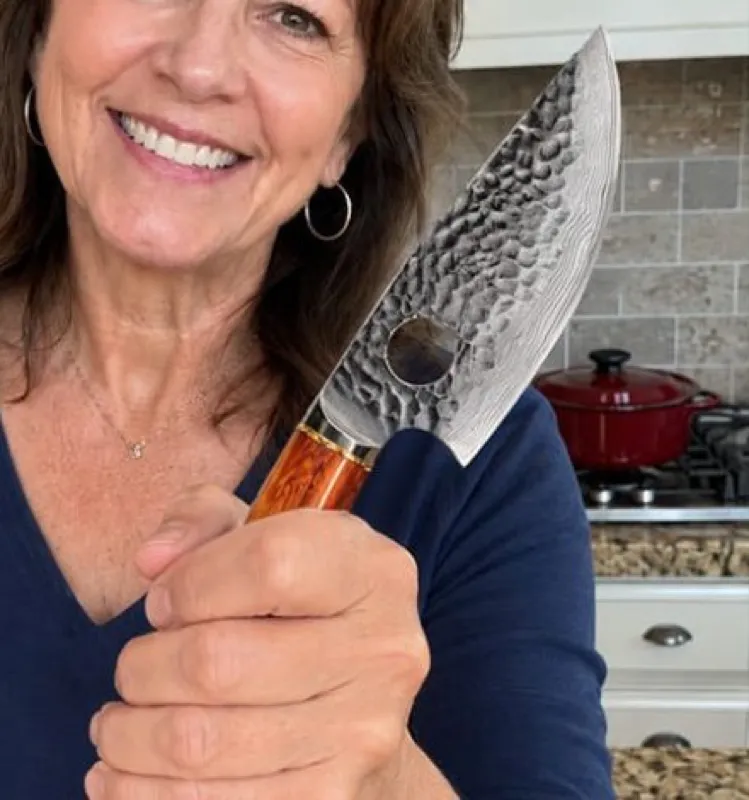
Pair it with: the Matsato Osuren chef knife
Hammered Japanese-style steel blade with a 12° edge, a finger hole for control and a pakka and acacia wood handle. $29.95 for one, or $19.98 each in the 4-pack.
Check today's Matsato price →60-day money-back guarantee · free recipe book with your order
How do Japanese and German chef knives compare?
| Feature | Japanese-style | German-style |
|---|---|---|
| Edge angle | About 12–15° per side | About 17–20° per side |
| Blade | Thinner, lighter | Thicker, heavier |
| Steel | Usually harder, holds a fine edge | Usually softer, tougher |
| Blade shape | Flatter profile, great for push cuts | More curved belly, great for rocking |
| Best at | Vegetables, herbs, fish, thin slicing | Squash, bone-in meat, heavy chopping |
| Feel | Nimble, precise | Solid, weighty |
| Care | Hand-wash, avoid bones and frozen food | Hand-wash, more forgiving |
Neither style is "better" in every way. They're designed for different priorities: precision and sharpness on one side, toughness and weight on the other.
Why does the edge angle matter so much?
The edge angle is how steeply the blade is ground to meet at the cutting edge. A smaller angle means a thinner, sharper edge that slides into food with less force. Japanese-style knives are usually sharpened at around 12 to 15 degrees per side, and German knives at around 17 to 20.
In the kitchen, that difference is easy to feel. A thin edge goes through a ripe tomato without squashing it, slices onions without crushing the cells (so you get fewer tears) and lets you cut herbs cleanly instead of bruising them. A wider edge is more robust, so it shrugs off knocks against bone, hard rinds or a careless toss into the sink.
Our guide on how to sharpen a chef knife explains how to keep each angle sharp at home.
How do the steels differ?
Steel hardness is measured on the Rockwell scale (HRC). Many Japanese-style knives use harder steel, often around 58 to 62 HRC, while many German knives sit around 55 to 58 HRC. In simple terms:
- Harder steel holds a fine edge longer, so the knife stays sharp between sharpenings. It's less forgiving if you twist the blade or hit bone.
- Softer steel is tougher and less likely to chip. It goes dull a little faster but is easy to hone back into shape.
Both are made from stainless steel in most modern kitchen knives, so rust isn't a big concern if you dry the blade after washing. The history of the chef's knife shows how French, German and Japanese traditions shaped these designs over time.
Is a heavier knife better?
Not necessarily. A heavy German knife uses its weight to power through hard foods, which is useful if you break down whole chickens or cut big winter squash often. But a heavy knife also tires your hand and wrist during long prep sessions.
A lighter Japanese-style knife lets the sharp edge do the work. For everyday cooking, like dicing onions, slicing peppers, mincing garlic and chopping herbs, most home cooks find a lighter knife more comfortable and more precise. If you have smaller hands or wrist pain, a lighter knife is often the better choice.
How does each knife cut?
German chef knives have a pronounced curve along the edge, called the belly. That curve suits a rocking motion: the tip stays on the board while you rock the heel up and down through herbs or garlic.
Japanese-style knives have a flatter profile. They're designed for push cuts and pull cuts, where you slide the blade forward or back through the food in a single smooth stroke. That motion gives cleaner, thinner slices and is very fast once you get used to it. Many modern Japanese-style chef knives, like the gyuto and santoku-inspired designs, keep a gentle curve so you can still rock when you want to.
Which knife is better for which tasks?
| Task | Better choice |
|---|---|
| Dicing onions and peppers | Japanese-style |
| Slicing tomatoes | Japanese-style |
| Chopping herbs | Either; Japanese for clean cuts |
| Slicing fish or boneless meat | Japanese-style |
| Cutting butternut squash | German-style |
| Cutting through chicken joints | German-style |
| Everyday weeknight cooking | Japanese-style for most cooks |
If most of your prep is vegetables, herbs and boneless proteins, which is true for most home kitchens, a Japanese-style knife will feel like an upgrade every single day.
Why do we like the Matsato Osuren as a Japanese-style knife?
Traditional Japanese knives from specialty shops can cost $100 to $300 or more. The Matsato Osuren brings the main benefits of the style to a much friendlier price:
- A fine edge of about 12°, sharp straight out of the box.
- A hammered, Damascus-pattern blade that helps food release from the side.
- A finger hole near the heel for a stable, controlled pinch grip.
- A pakka and acacia wood handle that feels warm and secure in the hand.
- An all-purpose shape for vegetables, herbs, meat and fish.
It costs $29.95 for one, with lower prices per knife in bundles, down to $19.98 each in the 4-pack. It comes with a 60-day money-back guarantee. Read our Matsato Osuren review and is the Matsato Osuren legit?
Get a sharp Japanese-style chef knife
Matsato Osuren: about a 12° edge, hammered blade, finger-hole grip and pakka and acacia handle. From $19.98 per knife in the 4-pack, with a 60-day money-back guarantee.
Check today's Matsato price →60-day money-back guarantee · free recipe book with your order
When is a German knife the better choice?
A German chef knife makes sense if you regularly:
- break down whole chickens or cut through small bones
- cut hard winter squash, pumpkins or large root vegetables
- prefer a heavy knife that feels solid in your hand
- tend to be rough with knives, such as tossing them in a drawer
Many cooks end up owning both: a Japanese-style knife for daily prep and a heavier knife or cleaver for the occasional tough job.
How do you care for a Japanese-style knife?
- Hand-wash it with warm, soapy water and dry it right away. Dishwashers dull edges and damage wooden handles.
- Use a good cutting board. Avoid glass, stone and ceramic, which are very hard on edges. See the best knife for a titanium cutting board.
- Don't cut bones or frozen food. Use a cleaver or a heavier knife for that.
- Hone regularly to keep the edge aligned.
- Store it safely on a magnetic strip, in a block or with a blade guard, not loose in a drawer.
Does the cutting board make a difference?
Yes. A thin, sharp edge is a joy on the right board and frustrating on the wrong one. Wood is the gentlest surface. Plastic boards are soft on knives but get scratched quickly and can shed microplastics into food over time. Titanium boards are plastic-free and very easy to clean; they're harder than wood, so regular honing keeps your edge in shape. See do titanium cutting boards dull knives? and plastic cutting boards and microplastics.
How often does each knife need sharpening?
A Japanese-style knife with harder steel usually holds its edge longer between sharpenings, but when it does need work, a whetstone gives the best results. A German knife may need honing more often but is easy to touch up with a honing steel. For most home cooks:
- Hone every week or two.
- Sharpen every 2 to 4 months if you cook most days.
- Avoid cheap pull-through sharpeners on thin Japanese-style edges; their fixed angle can be too wide and too rough.
Do handles differ between the two styles?
German knives traditionally have a full tang (the steel runs through the whole handle) with a riveted, contoured handle and a thick bolster where blade meets handle. That adds weight and balance toward the handle. Japanese-style knives often have lighter handles and a thinner heel, which keeps the balance closer to the blade and makes the knife feel nimble. The Matsato Osuren adds a finger hole near the heel, which helps you hold the blade in a stable pinch grip, the grip chefs use for control.
Is a sharper knife safer?
Yes, in most cases. A sharp knife cuts where you aim it and needs less force, so it's less likely to slip off a tomato skin or an onion and into your finger. Dull knives cause many kitchen cuts because you have to push harder. Use a stable board, keep your fingers curled in a "claw" shape and let the edge do the work.
What should you look for when buying a chef knife?
- Blade length: 8 inches is the most versatile size for home cooks.
- Comfortable grip: the handle should feel secure, even when wet.
- Edge angle: a finer angle for precision, a wider angle for toughness.
- Balance: the knife shouldn't feel too heavy at the tip or the handle.
- Guarantee: a generous return window lets you try it at home.
Is a Japanese-style knife a good gift?
A good chef knife is one of the most useful gifts for anyone who cooks. A Japanese-style knife feels special, looks beautiful on the counter and makes everyday prep faster. Pair it with a plastic-free cutting board for a complete kitchen upgrade. See gifts for home cooks.
The bottom line
Japanese and German chef knives are built for different priorities:
- Japanese-style: thinner, lighter, sharper, best for vegetables, herbs, fish and precise slicing.
- German-style: thicker, heavier, tougher, best for squash, bones and heavy chopping.
For most home cooks, a Japanese-style knife is the more satisfying everyday tool. The Matsato Osuren gives you a 12° edge, a hammered blade and a comfortable finger-hole grip from $19.98 per knife, with a 60-day money-back guarantee.
Pair it with: the Matsato Osuren chef knife
Hammered Japanese-style steel blade with a 12° edge, a finger hole for control and a pakka and acacia wood handle. $29.95 for one, or $19.98 each in the 4-pack.
Check today's Matsato price →60-day money-back guarantee · free recipe book with your order
Frequently asked questions
What is the difference between Japanese and German knives?
Japanese-style knives are thinner and sharper, at about 12 to 15 degrees per side. German knives are thicker and heavier, at about 17 to 20 degrees.
Are Japanese knives sharper than German knives?
Usually yes, because of the finer edge angle and harder steel.
Are German knives more durable?
Their softer, thicker steel is tougher and less likely to chip on bones or hard foods.
Which chef knife is best for vegetables?
A Japanese-style knife, because the thin edge slices cleanly without crushing.
Can Japanese knives go in the dishwasher?
No. Hand-wash and dry them right away to protect the edge and handle.
Is the Matsato Osuren a Japanese-style knife?
Yes. It has about a 12 degree edge, a hammered blade, a finger hole and a pakka and acacia handle.

Michelle Hert
Michelle is a home cook who cooks for a family every day and spends a lot of her free time reading the research behind the products that end up in our kitchens. She started Less Plastic Kitchen after the 2023 cutting board study made her look twice at the scratched plastic board on her own counter. Her guides are built on published studies, manufacturer specifications and verified buyer feedback, and she updates them when new information comes out. More about Michelle.