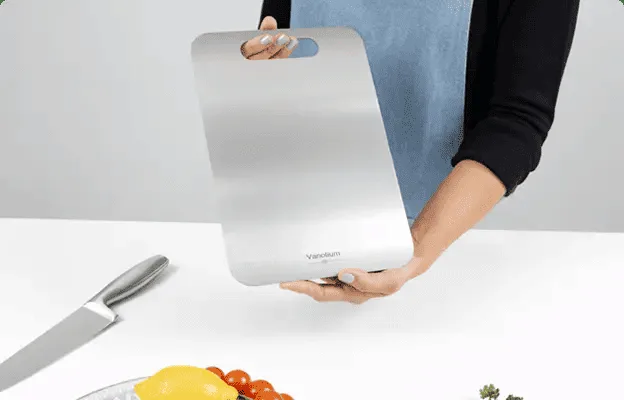
- Fine surface marks can appear over time, like on any metal surface.
- They don't turn into deep grooves the way plastic and wood boards do.
- Because the surface is non-porous, marks don't soak up juices or harbor bacteria the way knife scars in plastic can.
- No plastic comes off when you cut.
One of the biggest reasons people switch to titanium cutting boards is to escape the deep, fuzzy grooves that plastic boards develop, and the microplastics that come with them. So it's natural to wonder: does a titanium board scratch too? And if it does, is that a problem?
This guide gives an honest answer: what kind of marks to expect, how they compare with plastic, wood and glass, whether scratches matter for hygiene and microplastics, how knives affect the surface, and how to keep a titanium board looking good for years.
Why is titanium scratch-resistant?
Titanium is a strong, tough metal that resists denting, warping and corrosion. It's commonly used in aerospace, medical implants and high-end cookware because it's durable and doesn't react with food. A cutting edge can leave faint surface lines on almost any material, including metal, but titanium doesn't get carved into the way plastic does, and it won't develop the soft, raised fibers that make old plastic boards feel rough. See is titanium food safe?
How does titanium compare with other boards?
| Board | What happens with daily cutting | Hygiene impact |
|---|---|---|
| Plastic | Deep knife grooves and frayed surface within months | Grooves trap bacteria; sheds microplastics |
| Wood | Knife marks; self-heals somewhat on end-grain | Porous; needs oiling and careful cleaning |
| Bamboo | Hard; shows marks; glue in many boards | Porous; hand wash |
| Glass | Very hard; knives skid; edges dull quickly | Non-porous but hard on knives |
| Titanium | Fine surface marks over time, no deep grooves | Non-porous; no plastic; dishwasher-safe |
See titanium cutting board pros and cons and glass cutting boards.
Do scratches on a titanium board hold bacteria?
The concern with scratched plastic boards is that deep grooves hold food residue and moisture where bacteria can survive cleaning. The USDA recommends replacing cutting boards once they develop hard-to-clean grooves. Fine marks on a non-porous titanium surface are shallow and don't absorb liquid, so they wash clean with hot, soapy water or in the dishwasher. See cutting board scratches and bacteria.
Do scratches mean the board is shedding material?
With plastic boards, every scratch is plastic coming off the board, and a 2023 study in Environmental Science & Technology estimated that chopping on plastic boards can release tens of grams of microplastics per person per year. Titanium boards contain no plastic, so there are no microplastics to shed. That's the main reason many cooks switch. See plastic boards and microplastics.
Does titanium scratch your knives?
Every firm cutting surface wears a knife edge gradually; a titanium board is firmer than wood, so it's a good idea to hone your knife regularly, every week or two for daily cooks, and sharpen it a few times a year. Use a slicing motion rather than chopping straight down hard, and let the knife glide. Avoid serrated knives and heavy cleavers on any premium board. See do titanium cutting boards dull knives?
Is Vanotium scratch-resistant?
Vanotium is a titanium cutting board designed to be scratch-resistant and warp-proof. Its non-porous surface sheds no plastic, doesn't hold juices, stains or smells, is waterproof and fast-drying, heat-resistant enough to double as a trivet and dishwasher-safe. In October 2026 it was $66.66 for one board, $116.66 for two or $42.77 each in a four-pack, with a 30-day guarantee. On Trustpilot, Vanotium had a 4.0 rating from 63 reviews in October 2026. Read our Vanotium review, where we rate it 4.6/5.

A board that resists grooves and sheds no plastic
Vanotium titanium cutting board: scratch-resistant, warp-proof, non-porous and dishwasher-safe. From $42.77 per board in multi-packs, with a 30-day guarantee.
Check today's Vanotium price →Ships in 5–7 days with tracking · 30-day guarantee
How do you keep a titanium board looking new?
- Clean after each use with hot, soapy water or in the dishwasher.
- Dry it to avoid water spots, especially with hard water.
- Use a slicing motion rather than hard chopping.
- Avoid serrated knives, cleavers and bone cutting.
- Remove water spots with a little white vinegar on a soft cloth, then rinse.
- Store it upright or flat, away from other metal tools that could knock against it.
See how to clean a titanium cutting board.
Are fine marks just cosmetic?
Yes, for the most part. Light surface lines on metal show up most under bright light at an angle and don't affect how the board cuts, cleans or performs. Many cooks find they blend into a soft, brushed look over time, much like a well-used stainless steel pan. What matters for health and hygiene is that the surface stays non-porous and doesn't shed plastic, which titanium does.
Is it really titanium?
Some cheaper boards are plastic or other materials with a metallic coating or finish. Those coatings can wear through, scratch and expose what's underneath. Before buying, check that the cutting surface is titanium itself, not a thin coating over plastic. Our guide to titanium vs titanium-coated boards explains what to look for.
How long does a titanium board last?
A well-made titanium board is built to last for years. Unlike plastic boards, which the USDA suggests replacing once they're deeply grooved, often every year or two for daily cooks, titanium doesn't warp, crack or develop deep grooves with normal use. That durability is a big part of its value over time. See are titanium cutting boards worth it? and when to replace a cutting board.
Which cutting habits protect any board?
A few habits protect both your board and your knives. Slice and rock the knife rather than chopping straight down hard. Don't scrape food off the board with the sharp edge; flip the knife and use the spine, or use a bench scraper. Keep the board stable on a damp towel so it doesn't slide. Use a separate board for very hard jobs like cracking nuts or bones. And clean the board soon after cutting acidic or salty foods, so residue doesn't dry onto the surface. These habits keep any board looking and working its best.
Does the dishwasher cause scratches?
Dishwashers don't usually scratch titanium, but metal tools rattling against the board during the cycle can leave marks. Place the board where it won't knock against cutlery or pans, or wash it by hand when you have a moment. Hard water can leave spots after drying; a quick wipe with diluted white vinegar removes them.
What should you realistically expect after a year?
After a year of daily cooking, a titanium board will usually show a fine pattern of light surface marks where you cut most often, especially visible in bright light. What you won't see is what happens to plastic boards over the same period: deep, fuzzy grooves, stains from beets and turmeric, a lingering smell of garlic or onion, warping from the dishwasher, or a rough surface that grabs the knife. The board will still be flat, still non-porous, still dishwasher-safe and still free of plastic shavings. For most home cooks, that's the trade they're looking for.
Is titanium better than wood for scratches?
Wood is softer than titanium, so it shows knife marks more quickly but also "gives" with the blade, which is kinder to edges. End-grain wood boards can partly close up around cuts over time. The downside is that wood is porous: deep cuts can hold moisture and residue, and wood needs regular oiling and hand washing. Titanium shows fewer and shallower marks, needs no oiling and goes in the dishwasher. Many cooks keep a wood board for bread and delicate knife work and a titanium board for raw meat, fish and everyday prep. See wood vs plastic cutting boards.
Is a titanium board a good gift for someone worried about scratches?
Yes. People who have thrown away grooved plastic boards or sanded down old wood boards often appreciate a board that holds up to daily use with minimal care. A titanium board is a practical gift for new homeowners, home cooks and anyone cutting back on plastic. See gifts for home cooks.
Why do marks look worse under kitchen lights?
Bright overhead or under-cabinet lights hit metal at a low angle and highlight every fine line, much like scratches on a stainless steel fridge. In normal daylight, or when the board is wet with food on it, the marks are hard to see. They don't change how the surface cuts or cleans.
Should you use both sides?
If your board can be used on both sides, rotating between them spreads wear evenly, and many cooks keep one side for raw meat and the other for produce.
The bottom line
Titanium cutting boards are scratch-resistant but not scratch-proof: fine, mostly cosmetic marks can appear over time, but they don't become deep, bacteria-trapping grooves like plastic, and no plastic is shed. With good knife habits and simple care, a titanium board stays hygienic and looks good for years.
For a scratch-resistant, plastic-free board, our pick is Vanotium. Check today's Vanotium price and multi-pack deals.
Sources
- USDA Food Safety and Inspection Service. Cutting Boards and Food Safety.
- Yadav H. et al. Cutting Boards: An Overlooked Source of Microplastics in Human Food? Environmental Science & Technology, 2023.
- Trustpilot. Vanotium reviews (October 2026).
Frequently asked questions
Do titanium cutting boards scratch?
They're scratch-resistant but not scratch-proof. Fine surface marks can appear over time, but they don't become deep grooves like plastic.
Do scratches on titanium boards hold bacteria?
Fine marks on a non-porous titanium surface are shallow and don't absorb liquid, so they wash clean, unlike deep grooves in plastic.
Does a scratched titanium board release microplastics?
No. Titanium boards contain no plastic, so there are no microplastics to shed.
Will a titanium board damage my knives?
Like any firm board it wears an edge gradually. Hone regularly, use a slicing motion and avoid serrated knives and cleavers.
How do I remove water spots from a titanium board?
Wipe with a little white vinegar on a soft cloth, then rinse and dry.
Is the Vanotium board scratch-resistant?
Yes, it's designed to be scratch-resistant and warp-proof, non-porous and dishwasher-safe. From $42.77 per board in multi-packs.

Michelle Hert
Michelle is a home cook who cooks for a family every day and spends a lot of her free time reading the research behind the products that end up in our kitchens. She started Less Plastic Kitchen after the 2023 cutting board study made her look twice at the scratched plastic board on her own counter. Her guides are built on published studies, manufacturer specifications and verified buyer feedback, and she updates them when new information comes out. More about Michelle.